Showing posts with label Obstacles. Show all posts

Apr 8, 2013

Sympathy for the Devil

“Please allow me to introduce myself,” says The Devil in the Rolling Stones’ classic tune “Sympathy for the Devil.” 

by *mimulux

Unfortunately, devils are not usually so obvious. By nature, they are devious and hard to identify. In addition, our powers to discern good and evil are diminished by two things: our own ignorance or delusion and the cunning of “the devil himself.”
In Nichiren Buddhism “devils” symbolize a function of life. No one actually is a devil, but everyone has the potential to think and behave in a devilish fashion. Terms like devil and evil define modes of human behavior—our own or others’—that can hinder our ability to respect the Buddha nature in ourselves or in others.
Nichiren Daishonin writes of how difficult it is to discern good from evil while in an unenlightened state. He refers to this as a “dream realm,” in which our minds are “invariably engaged with phantoms, and so it gives rise to phantom capacities, phantom receptiveness, phantom responses…” (The Writings of Nichiren Daishonin, vol. 2, p. 836). Or, he writes, that people have “become drunk on the bad liquor of inner darkness” (WND-1, 478). To awaken from our dream state, to sober from our drunkenness of ignorance, we practice Buddhism as members of the SGI, dedicated to awakening and encouraging one another.
Sneakiness and cunning are the devil’s calling cards; according to Nichiren, obstacles and devilish functions arise in “confusing form” (WND-1, 281) to hinder one’s Buddhist practice, or to create division and mistrust among fellow Buddhists. For one who is taken in by these, he says, “The devil will watch over him like a parent” (WND-1, 770).
Devilish functions or the people who embody them often take on an attractive and sympathetic appearance like the “man of wealth and taste” in the Stones’ song. But to sympathize with those who behave in a devilish manner, who hinder the advancement of kosen-rufu, serves neither them nor ourselves. Their error is critical and driven by the worst in human nature—to diminish the value of others, to use others for their own gain, with the effect of estranging people from the community of believers who propagate the most powerful Law, which can relieve suffering.
Shakyamuni Buddha thoroughly reproached his follower Devadatta, who, out of jealousy, tried to destroy the Buddhist Order. The Buddha harshly criticized him in public to alert everyone, including the transgressor, to the seriousness of the offense. SGI President Ikeda explains: “It is by denouncing evil that we can cause such people to open their eyes. That is because hearing voices resounding with the justice of the Mystic Law has the effect of activating the Buddha nature that lies dormant in an evil person’s heart” (June 2003 Living Buddhism, pp. 37–38). When we do this, Nichiren says, we are acting as the offender’s “parent.”
Buddhism does not view good and evil as a duality, as existing independent of one another. Even a Buddha possesses the potential for evil. If this were not so, the principles of “mutual possession of the ten worlds” or “three thousand realms in a single moment of life” would not be true. The potential inherent in any condition of life are all the other possible conditions. The Buddhist principle called the “oneness of good and evil” means that where there is evil, good is an ever-present potential, where there is good, evil is always a possibility. As Nichiren writes, “Good and evil have been inherent in life since time without beginning” (WND-1, 1113). Since both good and evil are always present in all life, it becomes each person’s continual challenge to encourage and nurture good and to suppress evil.
Also, the good and evil we may see in others reflects the good and evil in our own lives. They are universal potentials. “I can see me in you” and “I can see you in me” is a viewpoint basic to Buddhism.
As Buddhists, we do not presume that anyone is exclusively evil, with no potential for good. Nor do we assume ourselves to be exclusively good and incapable of error. Such attitudes are non-Buddhist. To identify evil and discuss it with the conviction that this will lead to the growth and benefit of all involved is the purpose of Buddhist dialogue. In doing so, our aim should always be to inspire and empower others and to unite people rather than divide them.
—Dave Baldschun 

Mar 29, 2011

Challenging our Weakness

Challenging our weakness is the key to believing in ourselves
By Linda C. Johnson, SGI-USA Vice General Director, Los Angeles (from Living Buddhism, January 2003) 

“I had to ask myself whether I truly believed in the power of my prayer to break through my own fears and insecurities.”

I want to unconditionally love myself. I want to embrace every part of me. I want to believe, without reservation, that my life is Nam-myohorenge-kyo itself. My challenge is to believe these things amidst the realities of my daily life. It is a struggle, I believe, all of us face every day.

As I prepared to write this article, my deepest insecurities and fears emerged. I wondered: “What could I say that will inspire someone?” I bathed in those feelings; they enveloped me. As a consequence, I could not write a single word. I turned to prayer, chanting to be able to write an article that would encourage others and help them break through the deadlocks in their lives. But my doubts lingered. I fought them continuously, during the day whenever they arose, as well as when I sat chanting in front of the Gohonzon. In spite of how I was feeling, I poured my entire life into encouraging others during meetings and guidance sessions. I told them that, with faith, they had the power to do anything. In the meantime, I remained stuck.

It was as a result of my fervent prayer that I realized I would never be able to write anything as long as I permitted myself to hold on to the doubt in my ability to write an article that would encourage others. I turned to “Reply to Kyo’o,” one of my favorite writings by Nichiren Daishonin. In it, the Daishonin tells us: “Believe in this mandala with all your heart. Nam-myohorenge-kyo is like the roar of a lion. What sickness can therefore be an obstacle?” (The Writings of Nichiren Daishonin, p. 412).

I had to ask myself whether I truly believed in the power of my prayer to break through my own fears and insecurities. I prayed sincerely to trust what Nichiren Daishonin was telling me. I also prayed to have unshakeable confidence that, with prayer as my foundation, I could overcome my doubts and write an inspiring article. My doubt, however, did not disappear instantly. There were times while I was chanting that it felt as if every cell in my body wanted to run away. The television was calling me. The telephone was ringing. I had chores to do. I returned to “Reply to Kyo’o”: “A sword is useless in the hands of a coward. The mighty sword of the Lotus Sutra must be wielded by one courageous in faith. Then one will be as strong as a demon armed with an iron staff. I, Nichiren, have inscribed my life in sumi ink, so believe in the Gohonzon with your whole heart” (WND, 412).

This was my answer. I had to muster the courage to confront my fear. No matter how painful my current situation, I could not back down. For days, I continued to challenge my insecurity with prayer while immersing myself in activities to help others overcome their problems. Then, the day before I was scheduled to submit my article, I had my breakthrough. I had finally understood why I had been going through so much agony. The issue wasn’t the article. I needed to confront my own doubt, my own lack of belief in my inherent power to challenge and win over my fears and insecurities.

Whether we are writing an article, facing illness, being terminated from a job or looking for our soul mate, the process is the same. We must transform our weaknesses into strengths. We must face our suffering and triumph over it. This experience became the catalyst for me to explain how one uses faith to transform challenging daily life situations into an uncompromising opportunity for growth. This, I believe, is the essence of the concept of the oneness of good and evil.


Nichiren Buddhism makes it clear that everything and everyone in life has both a good and an evil side. I know that some people have an immediate negative response to the word evil. Evil also is synonymous with the words selfishness and self-centeredness. Life at every moment is a battle between these two opposing forces of good and evil. In other words, when we manifest our Buddhahood, it does not mean that our self-centeredness goes away. Instead, our ability to continue to uncover more of our potential is directly related to our ability to create value using the self-centered side, rather than allowing it to affect us negatively. In other words, the impact that our own self-centeredness or that of others will have on us is based on our response to it.

In Webster’s New World Dictionary, one of the definitions of respond is “to have a positive or favorable reaction.” This definition accords with Nichiren Buddhism, the Buddhism of true cause. We cannot change the past. In this moment, however, with our thoughts, words, and actions, we are creating our future. In this moment, through our actions, we have the opportunity to change anything and everything. Isn’t that the meaning of true cause? We affect change by how we respond to our circumstances. For example, rather than an automatic negative response to difficult circumstances, we must, like the definition, “have a positive or favorable reaction” in order to create the outcome we are seeking.

Many of us think that if we don’t do anything the problem will just go away on its own. This is not the case. Even if it seemingly goes away temporarily, it comes back bigger and stronger.

President Ikeda explains: “The strength of our mind of faith changes suffering into joy, into a tailwind to propel our further advance. This is what the ‘Devadatta’ chapter teaches. Nichiren Daishonin says: ‘Devadatta was the foremost good friend to the Thus Come One Shakyamuni. In this age as well, it is not one’s allies but one’s powerful enemies who assist one’s progress’ (WND, 770). 

To attain Buddhahood, we have to thoroughly conquer our own inner evil. The concrete means for doing so is struggling against and defeating external evil. Struggling to defeat evil enables us to polish and purify our lives and attain Buddhahood. Because we strive against the ultimate evil, we attain the ultimate good” (The Wisdom of the Lotus Sutra, vol. III, p. 84).

In other words, the oneness of good and evil means that where evil exists, there is the potential for good, and where good exists, there is the potential for evil. Whether evil is transformed into something good is totally dependent upon our reaction to evil. Do we use our circumstances as a justification for our failure, or do we use our circumstances as an opportunity to develop our strength? When we challenge evil with the spirit that we will create something of value out of it, then evil functions to propel us forward. It becomes the catalyst for our growth. “If evil functions to reveal good, then evil in its entirety becomes good. This is truly the oneness of good and evil. But if evil is simply allowed to run its course, then it does not become good. Only when evil is thoroughly challenged and conquered does it become an entity of the oneness of good and evil” (The Wisdom of the Lotus Sutra, vol. III, p. 83).

Art by Seleus


In addition to our individual lives, this principle also applies to the situation we are facing with Nichiren Shoshu. We live during a historic time, a time when we have the opportunity to prove the correctness of Nichiren Buddhism by the way we respond. Nikken is changing Nichiren’s teachings by proclaiming, for example, that people can only attain enlightenment by going through him. Are we going to permit Nikken to change the teachings, or are we, through our efforts, going to ensure that everyone has the opportunity to practice Buddhism correctly as taught by Nichiren? Are we going to prove that Nikken is wrong by showing the undeniable growth of the lives of SGI members throughout the world?

Happiness, from the perspective of Nichiren Buddhism, is not a state of life in which there are no problems. Instead, happiness is to be found in challenging and winning over our problems. I believe that the happiness we seek is the feeling that occurs whenever we cross that finish line, in spite of the fact that our heart is pounding, our feet hurt, and our lungs feel as if they are about to explode. That feeling of triumph against all odds is a state of pure joy that no one can give us, no matter how much they might love us. It is a state that we can achieve only through our own efforts.


This state of happiness is also greatly enhanced through our efforts to help others. I continually find that whenever I do my best to encourage another person in faith, no matter how I am feeling, my life-condition is positively transformed. Giving to others expands our own lives in wonderful, sometimes unimaginable ways.
We must, therefore, perfect our practice for ourselves and for others. Both aspects are essential parts of our practice. Not only must we challenge our own weaknesses, we must use our lives to help others win. For example, do we take the responsibility to help our friends in faith have a victory? Do we pray to make this happen? Maximum growth requires that we perfect both parts of our practice.

In this regard, I must mention that I have recently met many members who are stuck in what I call a maintenance practice. They are comfortable, even if it means being comfortable with being uncomfortable. They have lost their seeking spirit, the will to seek out challenges. They have no personal goals. This is a dangerous condition because, from my own experience, it robs us of our passion and enthusiasm for life. We are not even aware of what is happening at first. By the time we are conscious that our lives are missing something, our apathy has become highly developed, and it seems almost impossible to change.

There is no neutral gear in life. We are either going forward or backward at every moment. We need goals. They make us alive and deepen our understanding of this Buddhism. After all, how can we see change if there is no standard by which to measure growth? Challenging and achieving goals are the means we use to prove to ourselves as well as to others the power of the Mystic Law.

I believe that the challenge facing every human being is the ability to truly love and believe in oneself. What I have learned as a result of facing my insecurities and fears during the process of writing this article is that I do not
need to rid myself of weakness. Instead, I must train myself to learn how to use it as my motivation to create positive change in my life. The power to make this possible is sincere prayer based on a powerful determination. Prayer makes what we normally would consider impossible into something possible.

I’m sure you are all familiar with the song “Wind Beneath My Wings.” Negativity self-centered-ness and obstacles can be the wind beneath our wings that propels us to soar even higher. Viewing challenges this way may require rethinking the way we live our lives. I am convinced, however, that living this way is the key to experiencing a joyflul, fulfilled existence; one in which we will come to know and believe that Nam myoho-renge-kyo is life itself.

Success is triumphing over challenges. We must challenge ourselves to do everything we think we cannot do. Only then will we truly come to know that we have nothing to fear because, with the Mystic Law as our foundation, we can transform any weakness into strength. That being so, I think you and I are perfect just the way we are.

Oct 26, 2010

Obstacles and Devils (Sansho Shima)


UKE March 1997 by Catherine Cinnnamon 

The three obstacles and four devils is a literal translation of the Japanese term sansho shima. This is a traditional classification of the types of difficulties and obstacles we encounter when we practise Buddhism.

Obstacles usually refers to external problems we may meet, whereas devils refers not to scary demonic spirits, which do not really exist, but rather to our own innermost negative tendencies, or the workings of life's innate deluded nature. We could say that obstacles are anything that functions to obstruct our practice of faith, whereas devils are self-destructive and destroy the quality of life itself.

The two best-known letters in which Nichiren Daishonin explains these obstacles and devils were both written to the Ikegami brothers, whose father threatening to disinherit them because of their refusal to give up their faith. This was a serious matter in those days. In the first of these, 'Letter to the Brothers', Nichiren Daishonin warns:
As practice progresses and understanding grows, the three obstacles and four devils emerge, vying with one another to interfere (MW-V1 p.145, WND p.501)
Once we start practicing we soon realize that constant effort is necessary to maintain a consistent practice; the same is true of attaining the supreme life-condition of Buddhahood. Even the difficulty of believing we can manifest this condition, or that everyone has it, can in itself be an obstacle.

In 'Letter to Misawa', Nichiren Daishonin writes, "Even if you should manage to overcome the first six (of the three obstacles and four devils), if you are defeated by the seventh, you will not be able to become a Buddha".
(MW-V3 p.252, WND p.894)

It is important, therefore, to recognize sansho shima and overcome it. The support of people who are more experienced in practicing Buddhism is often very helpful in enabling us to identify and overcome this negativity, as President Ikeda points out:
The human mind wavers and changes from moment to moment. Over time, one experiences confusion even regarding things that one has previously decided on. This is an unchanging aspect of life. For precisely this reason, guidance and encouragement in the correct practice of faith are very important.
(Buddhism in Action, Vol.6, p.8)

He also says:
During the past forty years, I have been the target of unjustifiable criticism and faced raging waves of persecution again and again. However I have never been defeated in my struggles for kosen rufu… Time and again, I have transcended the raging waves of the three powerful enemies and the three obstacles and four devils. Each time, I did my utmost to carry out my faith exactly as the Daishonin taught. (ibid., Vol.6, p.360-1)
Nichiren Daishonin wrote: "Where it not for these (obstacles), there would be no way of knowing that this is the true teaching" (MW-V1, p.145, WND p.501).

It is precisely because the Mystic Law is a great positive force that the negativity inherent within us and our environment resists our attempts to strengthen it through our practice. If chanting Nam-myoho-renge-kyo had no power to change karma or draw out our Buddha nature, no one would experience any difficulty in practising it!

It is at a crucial time that obstacles or devils are most likely to appear. That is why the Daishonin emphasizes that we should neither fear them nor give in to them. In the second of his letters to the Ikegami brothers, 'The Three Obstacles and Four Devils', he says:
There is definitely something extraordinary in the ebb and flow of the tide, the rising and setting of the moon, and the way in which summer, autumn, winter and spring give way to each other. Something uncommon also occurs when an ordinary person attains Buddhahood. At such times, the three obstacles and four devils will invariably appear, and the wise will rejoice while the foolish will retreat. (MW-V2 p.288, WND p.637)

The important thing is to realize that when difficulties appear, they present an opportunity to make renewed efforts in our practice so that we are able to grow further and show proof of the power of Nam-myoho-renge-kyo. Obstacles and devils are a natural function of our practice and we should not be afraid of them - as our practice and faith deepens, we come to recognize the form our own particular demons take, tailor-made for each of us, so that we can continue to challenge ourselves in our quest to become really great human beings.

The three obstacles are:
 1. Earthly desires (bonno-sho), or obstacles arising from the three poisons of greed, anger and stupidity.
2. Karma (go-sho), or obstacles due to karma created by committing any of the five cardinal sins or ten evil acts (this category is also interpreted as opposition from one's partner or children).
3. Retribution (ho-sho), or obstacles due to painful retribution for actions in the three evil paths (Hell, Hunger and Animality). This category also indicates obstacles caused by one's sovereign, parents or other persons who carry some sort of secular authority.

The four devils are the hindrance of:
1. The five components (on-ma), that is, those hindrances caused by one's physical and mental functions.
2. Earthly desires (bonno-ma), or illusions arising from the three poisons.
3. Death (shima), because the fear and suffering that death entails, whether our own or someone else's can shake our faith and obstruct our practice of Buddhism, especially if death seems untimely.
4. The Devil of the Sixth Heaven (tenji-ma). This is regarded as the most serious hindrance; in Indian cosmology this king of devils represents the fundamental darkness inherent in life itself. This can assume any number of forms to obstruct believers and is often said to take the form of persecution by those in power. It is the most powerful of all the negative forces, and takes the form most likely to trouble us or cause us to suffer from doubt or illusion.

Aug 18, 2010

Jul 19, 2010

Chanting to become a Woman of Unlimited Self-esteem

Danny Nagashima

                                  comicallyvintage.tumblr.com

Chanting to become a woman of unlimited self-esteem - is the best medicine. When Amy chanted that way, everything in her life changed.

You can analyze your situation all you want . . . you have to get to the root of why you don't believe in the greatness of our own life. You have to grab the 'doubt of your greatness' by the root, and yank it out of your life. You must chant to awaken to your greatness. Chant to appreciate and value your own life. The answer is probably simple. But, since we over-analyze our situation, it gets complicated and the solution seems farther away. When Amy followed Danny's guidance, it was unbelievable what she felt inside. Your mission as a Buddhist is to be happy – not master suffering. We have the negative part of us, and the positive part of us. There's a part of us that believes we can do it, and then the negative part says, 'Who are you kidding?'

You have to fight to not give into your negativity. This is not just about your being a writer, a doctor, a secretary, or whatever your profession maybe. It is about you becoming the woman you always wanted to become - a woman who really values your life. This is an amazing opportunity. THE OBSTACLES YOU FACE ARE THE ANSWER TO YOUR PRAYERS. Those feelings of self-doubt, chase those feelings away -- 'I'm just a scam artist, doctor, lawyer, etc., a failure. – Those feelings you have to face and then chase them away. How you feel about yourself -- that feeling of self-loathing, of not being good enough, of not answering the phone, because it may be someone you are accountable to professionally - those are feelings you have to face and then chase them away.

                                   tumblr

Your talent is not the question. It's how you feel about yourself. This is karma. You need to value your own life, appreciate your own life . This has nothing to do with someone validating you. Amy said she followed her heart. She followed her Buddhahood and the effect from that, the benefit from that was MASSIVE. You have to follow your heart and truly treasure your life. When you sit in front of the Gohonzon, chant to have the most reverence for your life. The Gohonzon is the embodiment of your enlightened life. Your life deserves that kind of reverence. When Nichiren Daishonin inscribed the Dai-Gohonzon, he was chanting Daimoku already (out of the greatness of his own wisdom he inscribed the Dai-Gohonzon for all humanity) so everyone could relieve their own suffering.

IF YOU CAN CHANT FOR 2-WEEKS TO REALLY BE A WOMAN OF UNLIMITED SELF-ESTEEM, AND TO REALLY TRULY APPRECIATE YOUR LIFE, YOUR FLAWS, YOUR ACCOMPLISHMENTS, YOUR DEFEATS, YOUR LOSSES, YOUR VICTORIES, WHAT YOU HAVE CREATED, APPRECIATE YOUR TALENT - FOR 2 WEEKS—THEN EVERYTHING WILL CHANGE.

FORGET about all the past suffering in your life. That will just make you feel more impotent. Put it away. From now on, really chant about being a woman of unlimited self-esteem. Really appreciate everything from your life. – All the things about you, that make you incredibly unique and wonderful. And, remember that all the negative feelings – the heartaches—you will be able to use to inspire and help others. This is the suffering you need to share your experience and help others change. Focus on really, awakening your greatness. This is the opportunity you needed to go through, so that you can become outrageously successful. So you can fulfill your dreams. If you focus on this – really valuing your life now, then everything will fall into place. And, in a much bigger way—self worth and self-respect will emerge . And it is something no one can give you. The universe is showing you what you need to tackle.

When you first chant this way, a lot of negativity may come out of your life. Awful feelings may surface. Let it pass through you, like the flu. Transform the darkness. See the enlightened side of your fear. We always bring into our lives what matches our life condition, so don't fear it. Chant to feel incredible joy about your worth. When you get yourself to a place where you can absolutely see the miracle of your own life, the greatness of your own life, everything in your life will completely transform. We have to believe in our own Buddha nature. When we face the Gohonzon, we should say, 'I am going to praise my own wonderful life.'

It is important to awaken to our own greatness. Now is the time for you to start over. Your life is the Gohonzon! When you pray to a deity, your prayers are passive. Our lives are the Mystic Law. You must appreciate and value your own life. The Gohonzon is not outside of you. When you receive a benefit, it was you who created it. This is active prayer. You must awaken to your greatness. Believe in the greatness, in the magnificence of your own life. The Gohonzon is the manifestation of Nichiren Daishonin's enlightenment. Just as a beautiful piece of art elicits a response, or a great book touches your life in a certain way, we must elicit the Buddha nature from our own lives. It is right there. The Gohonzon is the perfect vehicle to bring out our greatest potential.

So, when you display your Buddhahood, bring out that strength, joy, that vibrant life condition, then you take that to the world and change the environment. We're not necessarily chanting for the house, the car, and the relationship . . . but we are chanting to elevate our life condition to attract that happiness . The results we see in our own lives are a reflection of our life condition. Every day, chant to manifest your Buddha nature consistently. Chant to rise above your basic tendency (I think mine is anger).

Chant with the expectation 'I WILL MANIFEST MY BUDDHAHOOD!' And that's what will arise. I create my own fortune. I am a Buddha, and I will manifest it everyday. I have to believe I deserve boundless happiness. The Buddha is who I really am. Every day I must manifest my Buddhahood and rise above the belief that I am a mere common mortal who does not deserve fortune in her life. Don't negate your life when you are in front of the Gohonzon. Don't beg, scream and don't berate the Gohonzon or your own life. The Gohonzon is the tool we need to bring out our Buddhahood. My life is the Gohonzon . Don't slander your life. I will fulfill every one of my dreams, for ME. We already possess something incredible – our Buddha nature, the Gohonzon. But sometimes we don't believe it.

But, we have everything we need to get us out of poverty, to transform our lives. But if I don't believe that the billion dollars (figure of speech for GREAT benefit) is mine, I won't be able to enjoy it. It is time to CASH THE CHEQUE. TRUST THAT THE GOHONZON IS THE ABSOLUTE MEANS FOR YOU TO TRANSFORM YOUR LIFE. TRUST IS THE KEY WORD. CHANT WITH THE EXPECTATION THAT EVERY ONE OF YOUR WILDEST DREAMS WILL BE FULFILLED BEYOND YOUR WILDEST IMAGINATION. CHANT TO BELIEVE IN YOUR BUDDHAHOOD. TRUST IN THE GREATNESS OF YOUR LIFE.

In 'On Attaining Buddhahood' Nichiren Daishonin makes the primary point – to free ourselves from the sufferings of birth and death we have endured in lifetime after lifetime and to attain absolute happiness we must awaken to the mystic truth that has always been within our lives – that truth is Nam-Myoho-Renge- Kyo. That truth is that I am a BUDDHA.

Amy got guidance to chant for the right man to come into her life for her happiness. It seemed too easy, she said. She questioned the guidance ''what if he is a midget? What if he is poor?'' But that day she met her husband. Trust the power of your Daimoku. Your life will be HUGE! Put your life first. Trust that ''billion-dollar check''(you are afraid to cash) does exist. Trust that you have EVERYTHING you need for your happiness – it is in the Gohonzon – it is in your life!

When you look at the Gohonzon know that you have exactly what you need to fulfill every prayer and become wildly, extraordinary happy!


Positive Discussion Points on Becoming Women of Unlimited Self Esteem

Ø Believe we can do it
Ø Fight to not give into negativity
Ø Become the woman you want to be
Ø Value your life
Ø Appreciate your life including your flaws
Ø Treasure your life
Ø Have reverence for your life
Ø Forget about the past sufferings in your life
Ø Believe that you are incredibly unique and wonderful
Ø Become outrageously successful at fulfilling your dreams
Ø Praise your own wonderful life
Ø Create your own benefit in your life
Ø Bring out our strength, joy and vibrant-life condition
Ø Believe in your own Buddha nature
Ø Realize that your life is the Gohonzon
Ø Manifest your extraordinary side
Ø Fulfill all of your dreams
Ø You have everything you need to transform your life

Negative discussion points on becoming Women of Unlimited self-esteem

Ø Not believing in our greatness
Ø Who are we kidding - we can't do it
Ø Feelings of self doubt
Ø Believing we are not good enough
Ø Self loathing
Ø Needing the validation of others
Ø I am a mere mortal who does not deserve fortune in my life
Ø Begging to, screaming to, or berating the Gohonzon/our own life
Ø I can't do it
Ø Holding on to past sufferings in our lives

Prayers to Enhance Becoming Women of Unlimited Self Esteem
Ø Chant to awaken to my greatness, my magnificence
Ø Chant to appreciate the value of my life
Ø Chant to be happy
Ø Chant to appreciate my talent
Ø Chant to feel incredible joy about my worth
Ø Chant to manifest my Buddha nature consistently
Ø Chant to rise about my basic negative tendency
Ø Chant to forget about the past garbage in my life
Ø Believe in my own Buddha nature
Ø Realize that my life is the Gohonzon
Ø Trust that the Gohonzon is the means to transform my life


Chant to become a woman of unlimited self-esteem

Every time you decide to put Love first it affects the energy of everyone and everything in your stratosphere. Hold a vision of Love with one-pointed concentration, and all that you've feared and resisted will change before you.

Jun 28, 2010

An Experience by Charles Johnson

By Charles Johnson

In the year of 1963, I was nine years old. My mother got me a membership to Uncle Ray’s Scrapbook club. Each week in the Worcester Massachusetts Telegram, the local Newspaper, Uncle Ray would write articles about History, Science and the World around us. The very first article I that I pasted into my scrapbook was an article and a picture of Shakyamuni Buddha. My Mother told me about the Buddha’s compassion for everything of this world. I told my mother at that time, this is how I would live my life.

It was many years later that a friend helped me to re-awaken what had been buried in my heart for so many years and led me to receive Gohonzon in Boston, Massachusetts in September of 2006...

In 2007, I worked as a Television Production Instructor for the United States Army’s, 3rd Psychological Operations Battalion at Fort Bragg, North Carolina. The work involved spending 2 weeks on Base and then 3 weeks off. The pay was phenomenal.

Then 2008 arrived and all the work dried up as all of my students were being deployed around the world. I had enough money for food and to pay my mortgage for 5 months and that was it. When you work as a contractor to the Military there is no unemployment. So, I started sending out resumes and looking for work online.

On top of being out of work with no income, in March of 2008, my best friend, my 17 year old cat, became gravely ill. I was faced with the hardest obstacle of my life as it was necessary for me and a veterinarian to ease his suffering and help him go home.
The road I was traveling had gotten very dark, but I managed to keep the light of hope and strength burning brightly by doing Gongyo twice a day and chanting continuously.

As the end of May rolled around, I had enough money for my June mortgage payment, leaving me with $35. dollars in my savings account.
I chanted with ever growing Faith and Determination, to find a job where my skill set would be highly sought after by a company whose product I could truly say I believed in. I wanted to be part of a team that made a positive difference in this world by bringing truth and not fantasy to people.

                                             ~FireFlyGal

By mid-June, I cut back to one meal a day. As I made a bowl of rice one evening, I placed a teaspoonful of uncooked rice in a small cup and set it in front of my Gohonzon as I started my evening prayers. I still have the same cup of rice on my altar today.


The very next day, I received a phone call from Discovery Communications. They said they had read my resume on line and asked if I could come to Silver Spring at their expense for an interview. During the third week of June I flew from Massachusetts to Silver Spring and met with 4 executives that showed me the Engineering facility and grilled me for several hours with technical questions.

I flew home the same day and felt that the interview went very well. The next day I received a call from Discovery with a job offer that exceeded my wildest dreams. The offer of course I accepted.

They immediately put me in touch with their relocation company which helped me put my house up for sale and they provided me with a $5000. check toward my initial moving expenses. A portion of this money enabled me to pay my July mortgage. Then to top it all, they said that they would pay for all of my moving costs. So, I drove on June 29 to my sister’s house in Centreville, Virginia. Bringing with me, my clothes, laptop, Gohonzon and Butsudan, and my books.

I started work on July 1, 2008 and stayed at my sister’s house for a little over a year. Each day I would take the Metro from Vienna to Silver Spring and back again in the evening. My commute of three hours a day could have been tedious, but during this time I was able to read both volumes of the Writings of Nichiren Daishonin, The Lotus Sutra and the entire series of The Wisdom of The Lotus Sutra.

One day last June, I had gotten out of work around 4 PM, which I was thrilled at after working several 50 hour work weeks. I boarded the Metro at Silver Spring Station and headed for home.

I settled into a seat reading the last volume of Wisdom of The Lotus Sutra, and was deep in thought. Suddenly time seemed to slow down as I heard the horrible sound of metal smashing into metal. Our train had crashed head on into the rear of another train. There was a dead silence as we came to a stop. During the crash I felt a cushion around me and when we had stopped moving, I stood up, completely unharmed. I checked with the other passengers in the car and no one was injured. Myself and several other men made our way from the fourth and third cars and proceeded to the second and first car.

When we arrived at the front of the second car several men tried pulling down the ceiling that was blocking the door, Only to reveal a cross beam across the top of the door making it impossible to open . It seemed that we were purposely prevented access to the front car and prevented from witnessing the horror of 9 dead passengers. Again I felt the protective forces were guarding me and the others.

As the side doors opened, I helped men and women exit from the train and we all stood on the side of the tracks until the fire department cut throught the chain link fencing and we were able to move to a parking lot.

The injured were separated to one side and 11 of us that were not injured were told we could leave. So, we started walking toward the Fort Totten station, no one spoke. I called my brother-in-law to come and pick me up and finally arrived at the house around 9:00PM.
The next day I went back to work and received an email from the President of Discovery saying that he was happy that I was ok and if I needed anything at all, not to hesitate in contacting him.

The fact that I came through the crash totally unscathed can only be attributed to the protective forces of shoten zenjin.

In the The True Aspect of All Phenomena Nichiren Daishonin wrote:
“Be sure to strengthen your faith, and receive the protection of Shakyamuni Many Treasures, and the Buddhas of the ten directions.”
[No.40, Page 386, col 2, paragraph 17,


During my lifes difficult times, a quote from President Ikeda encouraged and strengthened me:

“You must be strong. There is no hope of winning in this chaotic world if you are weak. No matter what others do or say, it is important to develop your ability and then put that ability to use. Strong Faith, of course, is the best means for drawing out ones inner strength. You each have a very important mission, and I hope you will awaken to and be proud of that mission.”

President Toda once said: “If you have a problem, just pray for the solution. Buddhism is an earnest struggle to win. I’ll stake my life on the fact that if you practice wholeheartedly, all of your prayers will be realized.”


This is what I have learned thus far in my life?
I have learned that there are always obstacles and difficulties in this life, but, how we deal with obstacles and difficulties can open the door to a world of opportunity. I have learned that when an obstacle presents itself to me, I will ask myself,
What cause did I make to create this obstacle?
What must I learn from this obstacle?
What is the best way to overcome this obstacle?
Once I have answered these questions, the possible emotional severity created by the obstacle diminishes and I can overcome the obstacle with Courage, Confidence, Compassion, Wisdom and Determination . All these qualities taught to us in our Practice of Nichiren’s Buddhism.
Thank you for letting me share my experience with you.
Nam Myoho Renge Kyo

Dec 1, 2009

Obstacles

Animation by Seleus


Oct 23, 2009

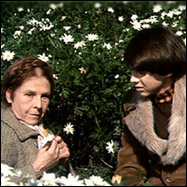
Harold & Maude...& Buddhism

by Seleus Blelis

There are a slew of films with Buddhist themes from The Wizard of Oz, Singin' in the Rain, The Matrix and Groundhog Day. But a couple of years ago before I received my Gohonzon, I saw a little film called Harold & Maude (1971).  Let's just say the rest is history. The film took on a significance with me that can only be summed up in two words- Be Happy.

 
I was studying and asking questions about Nichiren Buddhism at the time and I couldn't get over how Buddhist Maude was. She came into this young man's life for a specific reason, it was no coincidence. Speaking for myself, you see and/or taught that happiness is temporary, fleeting, take it while you can. Suffering is a part of life and happiness is not possible.  Harold's problem and for the majority of people is that we are fundamentally unhappy. As the film unfolds, I couldn't get over how happy Maude was. She displayed an array of human emotions from sadness to joy, but maintained an indestructible spirit. The lessons of life she was teaching wasn't only for Harold but for the audience.


In essence, she was shakabuking us and I recognized this right away. How do you become happy? "Appreciate your life. You are a Buddha. You are the best thing that ever appeared on this whole planet. You are the greatest thing in the whole universe. If you believe that there is nothing you cannot do with your life, then there is nothing you cannot do. To believe that you can do anything is to bring your life into harmony".- (Mr. Sonoda: 2000).

Here are a few examples of Maude's wisdom:

                                                          Source

Free yourself from attachments that cause suffering-   
 "Well, if some people are upset because they feel they have a hold on some things, then I'm merely acting as a gentle reminder - I'm sort of breaking it easy. Here today, gone tomorrow, so don't get attached to things."  

Have a positive attitude-  "Greet the dawn with the Breath of Fire!"

Relish every moment of your life-
"Don't play anything! Dear me. Everyone should be able to make some music. Why, it's life! - Rhythm and harmony - That's the cosmic dance. Come with me."

Experience your life-
 "I like to keep a variety. I'm always looking for the new experience, like this one.
something new each day to find it out. After all, we're given life."

Never give up-
"Reach out! Take a chance! Get hurt maybe. But play as well as you can. (she leads a cheer before the stands) Go team, go! Give me an "L." Give me an "I." Give me a "V." Give me an "E.
LIVE!!!!!"

Embrace your Humanity
"I cry at beauty - a first snow, a rose, a sunset. I cry when a man tortures his brother... when he repents and forgiveness is refused... and when it is granted.  begs forgiveness... when
To cry is to laugh. To laugh is to cry... a uniquely human trait. 
And the main thing in life, my dear Harold, is not to be afraid to be human."


In the Gosho, “Winter Always Turns to Spring”-
"Well, not dying, actually. I'm changing. You know, like from winter to spring.
Of course, it is a big step to take"

(Winter Always Turns into Spring- Nichiren Daishonin wrote the following:
 
Those who believe in the Lotus Sutra are as if in winter, which never fails to turn into spring. Never have I seen or heard of winter turning into autumn. Nor have I ever heard of any believer in the Lotus Sutra who remained a common mortal. A passage from the sutra reads, “Among those who hear of this Law, there is not one who shall not attain Buddhahood.”    (Gosho, p. 832; MW-1, p. 150)
In his explanation, the Daishonin compared the definitive principles of faith with the certainty of the changing of the seasons. Thus, just as winter turns to spring without fail, those who uphold faith in the Lotus Sutra will attain enlightenment without fail, even though they will definitely encounter obstacles.


I will end this post with my favorite scene that sums it all up