Showing posts with label Tsunesaburo Makiguchi. Show all posts

Mar 13, 2013

Good Friends


Ananda, one of Shakyamuni Buddha's closest disciples, once asked him: "It seems to me that by having good friends and advancing together with them, one has already halfway attained the Buddha way. Is this way of thinking correct?"

Shakyamuni replied, "Ananda, this way of thinking is not correct. Having good friends and advancing together with them is not half the Buddhist way but all the Buddhist way."
This may seem surprising, as Buddhism is often viewed as a solitary discipline in which other people might be seen as more of a hindrance than a help. However, to polish and improve our lives ultimately means to develop the quality of our interpersonal relationships--a far more challenging task than any solitary discipline. Our practice of Buddhism only finds meaning within the context of these relationships.

From another perspective, given that Buddhist practice of polishing and aiming to improve our lives from within is a constant challenge and a difficult process, it is only natural that we need support from others also dedicated to walking a correct path in life, trying also to create value in their lives.
SGI President Daisaku Ikeda has written, "Having good friends is like being equipped with a powerful auxiliary engine. When we encounter a steep hill or an obstacle, we can encourage each other and find the strength to keep pressing forward." And as Nichiren (1222--1282) wrote: "Even a feeble person will not stumble if those supporting him are strong, but a person of considerable strength, when alone, may lose his footing on an uneven path . . ."

In Nichiren Buddhism, good friends are known as zenchishiki or good influences, while akuchishiki refers to bad influences. People affect each other in subtle and complex ways, and it is important to develop the ability to discern the nature of that influence. According to Buddhism, "bad" friends are those who encourage our weaknesses. In Nichiren's words: "Evil friends are those who, speaking sweetly, deceiving, flattering and making skillful use of words, win the hearts of the ignorant and destroy their goodness of mind."


Even when intentions are good, the degree of our positive influence on each other will vary. Tsunesaburo Makiguchi, founder of the Soka Gakkai, used the following illustration. Say you have a friend who needs a certain amount of money. Giving your friend the money they need is an act of small good, while helping them find a job is an act of medium good. However, if your friend is really suffering because of a basic tendency toward laziness, then constantly helping him or her out may only perpetuate negative habits. In this case, true friendship is helping that person change the lazy nature that is the deep cause of their suffering.

A truly good friend is someone with the compassion and courage to tell us even those things we would prefer not to hear, which we must confront if we are to develop and grow in our lives.
Ultimately, however, whether people are good or evil influences in our lives is up to us. In Buddhist terms, the best kind of zenchishiki is one who leads us to strengthen our own faith and practice in order to thoroughly transform our karma. To quote Nichiren again, "the best way to attain Buddhahood is to encounter a zenchishiki, or good friend." Further, Nichiren comments that Devadatta, the cousin of Shakyamuni who tried to kill him and divide the Buddhist order, was "the foremost good friend to Thus Come One Shakyamuni. In this age as well, it is not one's allies, but one's powerful enemies who assist one's progress."

This expresses a key concept in Buddhism. Due to the immense transformative powers of Buddhist practice, even "bad" friends can have a good influence if we make our relationships with them into opportunities to examine, reform and strengthen our lives. The ideal is ultimately to develop the kind of all-encompassing compassion expressed by Nichiren when he wrote that his first desire was to lead to enlightenment the sovereign who had persecuted him, repeatedly exiling and even attempting to behead him.

Source: SGI Quarterly

Dec 16, 2012

Good and Evil

"If we lack the courage to confront evil acts, or tendencies toward hatred and discrimination, both within ourselves and in society, they will spread unchecked, as history shows. Martin Luther King, Jr., lamented, 'We will have to repent in this generation not merely for the hateful words and actions of the bad people but for the appalling silence of the good people.'"


Good and evil have often been looked upon as diametrically opposed and mutually exclusive. But in a real, practical sense, such a simplistic way of thinking is unsatisfactory. Even the cruelest of criminals may possess a strong sense of love or compassion toward his parents and children. Is such a person fundamentally good or evil?

The Buddhist understanding is that good and evil are innate, inseparable aspects of life. This view makes it impossible to label a particular individual or group as "good" or "evil." Every single human being is capable of acts of the most noble good, or the basest evil.

by sanguisGelidus


Moreover, good and evil in Buddhism are seen not as absolute but relative or "relational." The good or evil of an act is understood in terms of its actual impact on our own lives and the lives of others, not on abstract rules of conduct.

Evil actions are those which are based on a narrow selfishness, the delusion that our lives are fundamentally disconnected from those of others and that we can benefit at their expense. Evil views life as a means to be expended, not an end in itself. Good is that which generates connection between ourselves and others, healing and restoring the bonds among human societies.

In the context of Buddhism, good is identified with "the fundamental nature of enlightenment," or absolute freedom and happiness resulting from profound self-knowledge. Evil indicates "fundamental darkness," or life's innate delusion which negates the potential of enlightenment and causes suffering for oneself and others. This inner darkness echoes with the despair that our lives are ugly and meaningless; it also drives a wedge of fear that splits the hearts of people into "us" and "them."


A Buddha is someone who has the courage to acknowledge these two fundamental aspects of life. As Nichiren states, "One who is thoroughly awakened to the nature of good and evil from their roots to their branches and leaves is called a Buddha." Buddhas accept their innate goodness without arrogance because they know all people share the same Buddha nature. Buddhas also recognize their innate evil without despair because they know they have the strength to overcome and control their negativity.

Unwillingness to acknowledge the potential of both supreme good and evil can stem from the fact that as individuals we are reluctant to see ourselves as either very good or very bad, hiding instead behind a collective moral mediocrity that requires neither the responsibility of goodness nor the guilt of evil. And perhaps this moral ambiguity within seems to demand quick judgment of others-viewing those who serve our interests as "good people" and those whom we dislike as "bad people" as if to counterbalance that inner confusion with external clarity.

Some view Buddhism as a teaching of tranquility and repose--of passivity even--whereas in fact the practice of Buddhism is not about "staying safe." It is a constant struggle to create value and change evil into good through our own efforts to confront it. Nichiren writes, "Opposing good is called evil, opposing evil is called good."

Soka Gakkai founder Tsunesaburo Makiguchi, imprisoned for his criticism of Japan's wartime policies, is said to have engaged his fellow prisoners in a debate on the nature of good and evil, asking if there was a difference between not doing good and committing actual evil.

If we lack the courage to confront evil acts, or tendencies toward hatred and discrimination, both within ourselves and in society, they will spread unchecked, as history shows. Martin Luther King, Jr., lamented, "We will have to repent in this generation not merely for the hateful words and actions of the bad people but for the appalling silence of the good people."

In the words of SGI President Daisaku Ikeda, "The universe, this world and our own lives, are the stage for a ceaseless struggle between hatred and compassion, the destructive and constructive aspects of life. We must never let up, confronting evil at every turn."

And in the end, the evil over which we must triumph is the impulse toward hatred and destruction that resides in us all. The process of acknowledging, confronting and transforming our own fundamental darkness is the means by which we can strengthen the functioning of good in our lives.

[Courtesy October 2002 SGI Quarterly]

Jul 19, 2010

Daimoku—A “Lion’s Roar” of Happiness and Victory

(President Ikeda's Editorial 
 Translated from the November 2007 issue of the Daibyakurenge, the Soka Gakkai monthly study journal)


Singing
a joyous song of life
together,
let us vibrantly chant
invigorating daimoku.

The daimoku of Nam-myoho-renge-kyo serves as the hope-filled driving force for all people to realize their deepest wish of making the most of each and every day and leading a worthwhile and victorious life while brimming with the joy of being alive.
The Record of the Orally Transmitted Teachings states: “Great joy [is what] one experiences when one understands for the first time that one’s mind from the very beginning has been the Buddha. Nam-myoho-renge-kyo is the greatest of all joys” (OTT, 211–12).

The resonant chanting of daimoku is a supreme paean to human dignity and life, proclaiming that we ourselves are entities of Nam-myoho-renge-kyo. It is an invincible roar that fills our being with the immeasurable and unlimited power of the Buddha and the Law.

My mentor Josei Toda, who awakened to the essence of the Mystic Law during his imprisonment at the hands of the Japanese militarist authorities, gave the following guidance: “You must have this conviction: ‘I chanted with all my heart this morning. I’m going to do so again tonight. And I can chant right now. Therefore, whatever happens, I know everything will be all right.’ Chanting wholeheartedly through to the very end is the quintessential way to achieve the best possible outcome in all things.”

Daimoku
is an acclamation
of victory,
so chant confidently,
with the roar of a lion.

According to Indian philosopher Dr. Lokesh Chandra, with whom I have conducted a dialogue, Mahatma Gandhi (1869–1948) included Nam-myoho-renge-kyo in the prayers of his ashram. Gandhi, he said, recognized daimoku as the ultimate expression of the cosmic power that resides within each of us and a manifestation of life resonating with the ultimate rhythm of the universe.

In a letter to Gandhi, the French author Romain Rolland (1866–1944) wrote: “True prayer is [that] which, like yours, is offered in the midst of action.” Prayer leads to action. Prayer is the engine.

When Mr. Toda’s businesses were facing their direst crisis, I chanted resolutely to support my mentor and to build a new Soka Gakkai. I chanted and took action; took action and chanted. I prayed and exerted myself with all my being to transform the situation. There is no weapon more powerful than daimoku.

As Mr. Toda’s disciple, I strove all out in the spirit that the Daishonin describes as “diligent practice, exhausting the pains and trials of millions of kalpas in a single moment of life” (cf. OTT, 214). Through all these efforts, I was finally able to present my mentor with the accomplishment of total victory.

The prayers
of our great Soka women
are utterly fearless—
may they thoroughly
enjoy each day.


“Nam-myoho-renge-kyo is like the roar of a lion. What sickness can therefore be an obstacle?” (WND-1, 412), writes the Daishonin. Whenever you face an obstacle or challenge in life, vigorously set to chanting daimoku until it has been surmounted. Daimoku is a lion’s roar. It is the fundamental means for vanquishing all devilish functions and eradicating all evil.


Speaking of the tremendous power of the Mystic Law to transform poison into medicine, Mr. Toda declared: “We are the Bodhisattvas of the Earth and the followers of the Daishonin. We were born into this world as people who undergo various sufferings in order to demonstrate just how happy we can become through the power of the Mystic Law. Faith means leading a wonderful and meaningful life.”

In the history of the Soka Gakkai, in particular, we must never forget how the power of the earnest daimoku of our women’s and young women’s division members has enabled us to overcome innumerable trials and tribulations.

Nichiren Daishonin writes: “But no matter how others may chant Nam-myoho- renge-kyo, if they are persons who show enmity toward Nichiren, then without fail they will fall into the hell of incessant suffering. And then, after countless kalpas have passed, they will become Nichiren’s disciples and will succeed in attaining Buddhahood” (WND-2, 457). This applies equally to those who seek to harm the Soka Gakkai, which practices in the true lineage of the Daishonin.

Speaking to a pioneering member practicing alone in the early days of the Soka Kyoiku Gakkai (lit. Value-creating Education Society; forerunner of the Soka Gakkai), founding president Tsunesaburo Makiguchi said: “When the Daishonin first chanted Nam-myoho-renge-kyo, he was completely alone. The fact that you are the only one in your community to chant Nam-myoho-renge-kyo right now means that—in accord with the principle of bodhisattvas emerging from the earth—a second, and a third, and then a hundred others and more, all sharing the mission for kosen-rufu, will eventually appear.” Here we find the eternal formula for increasing our ranks of capable people in the realm of faith.

In Moscow 33 years ago (in 1974), at the height of the Cold War, I said to those accompanying me: “Let’s imbue the rich earth of Mother Russia with our daimoku. Someday, a steady stream of bodhisattvas will emerge from the earth here, too.” And that is exactly what has happened, and will continue to happen into the future.

Dr. Lou Marinoff, founding president of the American Philosophical Practitioners Association (APPA), with whom I have engaged in dialogue, said he was struck by the powerful sound of SGI members chanting Nam-myoho-renge-kyo, a practice that, he noted, was open to all people and served as a means for attuning one’s life with the dynamic rhythm of the universe.

Those who base their lives on chanting Nam-myoho-renge-kyo are philosophers possessing complete inner freedom, shining with a wisdom and vitality that are one with the universe and creating value in the promotion of peace and justice.
Mahatma Gandhi declared: “Prayer from the heart can achieve what nothing else can in the world.”

With optimistic confidence,
chant powerful daimoku
and win again today.


Oct 21, 2009

The Roots

Buddhism is one of the world's oldest religions. At its core are the quests to understand life and to help people overcome their basic sufferings. Nichiren Daishonin's Buddhism traces its origins to the teachings of Shakyamuni, who is said to have lived some 2,500 years ago. Known as Siddhartha Gautama in his youth, at age 19, he was a royal heir in India. His palace life was far removed from the everyday life of common people, and when he discovered how people suffered outside the palace walls, he set out to find out how to overcome the roots of basic human suffering.

He made it his life's purpose to find solutions to the inescapable sufferings of life. He sought the foremost teachers of his day and practiced the extreme forms of asceticism they advocated as the means to realize the ultimate reality of life. After following their teachings for several years, and on the point of death from fasting, Shakyamuni realized that their path was too extreme. He awakened to the wisdom of the "middle way," neither the extreme of austerity nor of indulgence.

After accepting food from a young girl, he sat down under the "Bodhi" (a pipal) tree. There he entered a profound meditation and finally attained enlightenment. He began at once to teach anyone who would listen. He would engage admirer and objector alike in dialogue and discourse to convey his awareness and insight into the human condition. Since the depth of Shakyamuni's understanding far surpassed that of even the most learned of his day, he had to prepare his listeners by first teaching them more easily understood doctrines, using parables and everyday analogies in the process. In this way, he could elevate the life-condition of those he taught, while always holding to his ultimate aim of showing people that they inherently possessed Buddhahood and could develop the qualities needed to conquer their sufferings.


For some forty years following his awakening at age 30, he imparted to others portions of his own enlightenment. During the final eight years of his life, he expounded his ultimate teachings, which were later compiled as the Lotus Sutra. The Lotus Sutra is unique among the teachings of Buddhism because it affirms that the attainment of enlightenment is possible for all people without distinction of race, gender, social standing or education. Buddhism, as epitomized in the Lotus Sutra, is a powerful, life-affirming, egalitarian and humanistic teaching.Following Shakyamuni's passing, various schools of Buddhism spread throughout Asia. It was only natural that a broad range of interpretive schools should emerge, since in his fifty-year teaching career he had employed a wide variety of means by which to transmit his enlightenment to people of various capacities and circumstances.


The Lotus Sutra gained particular prominence as it spread through Central Asia into China, the Korean Peninsula and Japan. At the same time, however, confusion began to reign as to the true nature of Buddhism and the relative superiority of the sutras. To solve the problem, leading minds of the time compared and systematized the various teachings; eventually a scholar from China called Chih-i (later known as the Great Teacher T'ien-t'ai) developed a definitive standard by which to judge them. This standard classified Shakyamuni's teachings according to the order in which he expounded them, the nature of the particular doctrine taught in each sutra and the method of its exposition. By classifying the teachings in this manner, T'ien-t'ai clarified that all the sutras were means of preparation for the highest teaching, the Lotus Sutra.


It was Nichiren Daishonin in Japan, however, who took the final all-important step to transform profound theory into a simple practice and thereby enable ordinary people to reveal their highest state of life in the midst of day-to-day realities. The Daishonin realized his purpose was to reveal this ultimate truth to the people of his time and for all eternity. Hence, Nichiren Daishonin's Buddhism is for the present age, and Shakyamuni and T'ien-t'ai prepared the way.

Nichiren Daishonin lived from 1222 to 1282 during a tumultuous time of social unrest and natural catastrophe. The son of a fisherman, he became a religious acolyte and after a period of intensive study he came to realize that the Lotus Sutra constitutes the heart of Buddhist teachings.
He also brought it out of the realm of theoretical contemplation into an actual experiential practice when he first chanted Nam-myoho-renge-kyo (Devotion to the Mystic Law) on April 28, 1253, and later inscribed the Gohonzon (the physical object of devotion for all humanity).
He subsequently dedicated his life to sharing his realization, despite facing numerous persecutions for preaching what was considered a subversive doctrine. By declaring that embracing this law had the power to allow all individuals to attain enlightenment, the Daishonin disturbed the ruling class of politicians and priests who adhered to other forms of Buddhism. Nonetheless, he gained a loyal following of believers. He especially embraced ordinary people from all walks of life.

After Nichiren Daishonin's passing, his closest disciple, Nikko, kept the true spirit of Buddhism alive. For the next six centuries, the Daishonin's Buddhism was maintained by a relatively small religious group until the early part of the twentieth century.

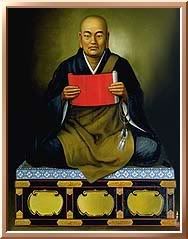
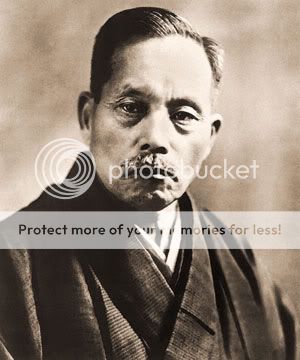
Tsunesaburo Makiguchi (1871--1944), an educator in Japan, was passionately dedicated to the reform of the Japanese educational system, which emphasized rote learning over critical independent thinking. He strove to develop modes of education that would unleash the potential of the individual. After studying Nichiren Daishonin's teachings, he realized that they could provide the philosophical underpinnings for the value-creating education that had been his lifetime goal.

In 1928, Mr. Makiguchi committed himself to practicing this Buddhism along with a young teacher, Josei Toda (1900s58), whom he had met in 1920. In 1930, they founded the Soka Kyoiku Gakkai, or "Value Creation Education Society," as a laypersons' organization, drawing its membership principally from among fellow educators.

Japan was then plunging headlong into war, a course diametrically opposed to the Buddhist reverence for life. As World War II progressed, the militarist government redoubled its efforts to crack down on all forms of dissidence. Mr. Makiguchi and Mr. Toda found themselves under increasing pressure to compromise their beliefs and practice the state religion of Shintoism.

Finally, the government asked the high priest of Nichiren Shoshu to accept a Shinto object of worship and enshrine it at the head temple. This would be in direct contradiction with the teachings and spirit of Nichiren Daishonin. The priests, fearful of their own safety and wanting to curry favor with the authorities, accepted this governmental order to protect themselves from persecution.
Mr. Makiguchi, however, refused to violate the spirit of the Daishonin's Buddhism. His resistance to the government order led to his and Mr. Toda's arrest and imprisonment as "thought criminals" in 1943 along with other Soka Kyoiku Gakkai leaders. Mr. Makiguchi, at 72, endured brutality and privation in prison, refusing on all counts to compromise his convictions. The records of his interrogations reveal a man propounding, without a trace of hesitation or fear, the very thoughts that had led to his incarceration. On November 18, 1944, he died at 73 in the Tokyo Detention House.

Josei Toda survived the ordeal and was released on July 3, 1945, just weeks before Japan's surrender. The Soka Kyoiku Gakkai had all but disintegrated under wartime persecution. Though physically ravaged by two years in prison, he immediately set about rebuilding the organization. It was renamed the Soka Gakkai (Value Creation Society).Mr. Toda resolved that the mission of this new organization should not be confined to the field of education but rather that it be expanded to the betterment of society as a whole. The Soka Gakkai rapidly grew under Josei Toda's leadership to more than 750,000 households by the time of his death in 1958.

His responsibilities were assumed by Daisaku Ikeda, who became the third president on May 3, 1960. Mr. Ikeda had met Mr. Toda at age 19 and committed himself to practicing the ideals of the Soka Gakkai, making Mr. Toda his mentor.


Mr. Ikeda has dedicated himself continually to fulfilling the visions Mr. Toda shared with him in the areas of peace, culture and education, based on the Daishonin's teachings. Through his international travels beginning in 1960, Mr. Ikeda has contributed greatly to Buddhism becoming a truly global religion. In 1975, the Soka Gakkai International was formed, and today, Nichiren Daishonin's Buddhism is being practiced by more than 12 million people in 128 countries under the auspices of the SGI.

The American organization was formed in 1960 when Mr. Ikeda visited the United States. At the time, there were just a handful of people practicing this Buddhism in the United States. They were primarily Japanese women who had married Americans, as well as some students from Japan. But with Mr. Ikeda's encouragement, they soon grew into a nationwide organization now called SGI-USA.

The SGI believes that the development of peace, culture and education are essential to building a better world. Centered on this ideal, the SGI carries out activities globally. In 1957, Josei Toda issued a declaration against the use of nuclear weapons, labeling them criminal under any circumstances; and he called upon youth of the world to work to abolish these weapons of mass destruction.
Taking up this challenge, the SGI, under Mr. Ikeda's leadership, has been working tirelessly to create the conditions for a peaceful world. The efforts to fulfill Mr. Toda's vision of peace have resulted in the SGI's wide-ranging activities, for instance, as a nongovernmental organization with official ties to the United Nations. The SGI has sponsored public information programs that aim through exhibitions, symposia and other forums to promote awareness of the issues of war and peace and the feasibility of peaceful alternatives. Major international exhibitions on such themes as disarmament, human rights and environmental protection have traveled throughout the world bringing public awareness of these critical issues.

Personally, Mr. Ikeda has engaged in dialogues with international academics and intellectuals like British historian Arnold Toynbee and with policy-makers and political leaders such as Zhou Enlai, Corazon Aquino, Mikhail Gorbachev and Nelson Mandela, exchanging ideas on how to create world peace and better understandings among people, and many other topics. He has received numerous awards and recognition from universities and nations around the world for his efforts to promote peace.

Applying the spirit of Buddhism to modern times, he has also founded several institutions dedicated to peace and intercultural dialogue. The Toda Institute for Global Peace and Policy Research conducts independent research and networks with peace researchers, activists and policy-makers to provide a global forum for the discussion and implementation of cooperatively designed policy strategies. And the Boston Research Center for the 21st Century provides a venue for pooling wisdom and fostering dialogue among the world's peace-oriented cultural, philosophical and religious traditions, thus developing a network of global citizens in the pursuit of peace.

In 1963, Mr. Ikeda founded the Min-On Concert Association, which has sponsored tours of performing groups from some seventy countries in order to promote understanding among diverse peoples through music, dance and other cultural expressions. He also founded the Tokyo Fuji Art Museum in 1983, which is engaged in a wide-reaching program of exchange with cultural institutions throughout the world.

Education has been of central concern to the Soka Gakkai since its inception, and many ideas set forth by Mr. Makiguchi and Mr. Toda have been brought to fruition through the Soka School System. From preschool to post-graduate, the Soka system undertakes education designed to stimulate wisdom and engagement within society. On May 3, 2001, Soka University of America will open as a full-fledged liberal arts college in Southern California.

At the heart of this global movement are discussion meetings. These neighborhood gatherings where people share experiences, encourage one another and study Buddhism together are the backbone of the SGI. They are forums where anyone can speak freely, ask questions, or simply sit and watch. Meetings are held regularly in homes or in community centers. The activities are free and anyone is welcome to attend and participate. Nichiren Daishonin's Buddhism is truly a religion that crosses all boundaries, with a diversity rarely seen in other institutions. This is proof that by overcoming our impasses, by winning over our own lack of understanding and constantly striving to awaken the Buddha nature inside each of us, we can build a lasting world peace.

There is no way to legislate, dictate or force peace onto humanity. As Daisaku Ikeda writes in the foreword to his book The Human Revolution: "A great revolution of character in an individual will help achieve a change in the destiny of a nation and further, will cause a change in the destiny of all humankind."

In our jigsaw-puzzle world, then, it soon becomes obvious that through each person becoming a winner and helping others to do the same, society will change.
This is Buddhism's blueprint for world peace or "Kosen-Rufu." The only way for people to live together in peace is for many individuals to awaken to the need for an inner revolution. For one happy person's influence on his or her environment will have a profound and lasting effect.