 |
by ~the-panpiperThere is nothing more fragile than the human heart. At the same time, there is nothing more indestructible. |
Mar 18, 2013
Heart

Mar 13, 2013
Good Friends

Ananda, one of Shakyamuni Buddha's closest disciples, once asked him: "It seems to me that by having good friends and advancing together with them, one has already halfway attained the Buddha way. Is this way of thinking correct?"
Shakyamuni replied, "Ananda, this way of thinking is not correct. Having good friends and advancing together with them is not half the Buddhist way but all the Buddhist way."
This may seem surprising, as Buddhism is often viewed as a solitary discipline in which other people might be seen as more of a hindrance than a help. However, to polish and improve our lives ultimately means to develop the quality of our interpersonal relationships--a far more challenging task than any solitary discipline. Our practice of Buddhism only finds meaning within the context of these relationships.
From another perspective, given that Buddhist practice of polishing and aiming to improve our lives from within is a constant challenge and a difficult process, it is only natural that we need support from others also dedicated to walking a correct path in life, trying also to create value in their lives.
SGI President Daisaku Ikeda has written, "Having good friends is like being equipped with a powerful auxiliary engine. When we encounter a steep hill or an obstacle, we can encourage each other and find the strength to keep pressing forward." And as Nichiren (1222--1282) wrote: "Even a feeble person will not stumble if those supporting him are strong, but a person of considerable strength, when alone, may lose his footing on an uneven path . . ."
In Nichiren Buddhism, good friends are known as zenchishiki or good influences, while akuchishiki refers to bad influences. People affect each other in subtle and complex ways, and it is important to develop the ability to discern the nature of that influence. According to Buddhism, "bad" friends are those who encourage our weaknesses. In Nichiren's words: "Evil friends are those who, speaking sweetly, deceiving, flattering and making skillful use of words, win the hearts of the ignorant and destroy their goodness of mind."

Even when intentions are good, the degree of our positive influence on each other will vary. Tsunesaburo Makiguchi, founder of the Soka Gakkai, used the following illustration. Say you have a friend who needs a certain amount of money. Giving your friend the money they need is an act of small good, while helping them find a job is an act of medium good. However, if your friend is really suffering because of a basic tendency toward laziness, then constantly helping him or her out may only perpetuate negative habits. In this case, true friendship is helping that person change the lazy nature that is the deep cause of their suffering.
A truly good friend is someone with the compassion and courage to tell us even those things we would prefer not to hear, which we must confront if we are to develop and grow in our lives.
Ultimately, however, whether people are good or evil influences in our lives is up to us. In Buddhist terms, the best kind of zenchishiki is one who leads us to strengthen our own faith and practice in order to thoroughly transform our karma. To quote Nichiren again, "the best way to attain Buddhahood is to encounter a zenchishiki, or good friend." Further, Nichiren comments that Devadatta, the cousin of Shakyamuni who tried to kill him and divide the Buddhist order, was "the foremost good friend to Thus Come One Shakyamuni. In this age as well, it is not one's allies, but one's powerful enemies who assist one's progress."
This expresses a key concept in Buddhism. Due to the immense transformative powers of Buddhist practice, even "bad" friends can have a good influence if we make our relationships with them into opportunities to examine, reform and strengthen our lives. The ideal is ultimately to develop the kind of all-encompassing compassion expressed by Nichiren when he wrote that his first desire was to lead to enlightenment the sovereign who had persecuted him, repeatedly exiling and even attempting to behead him.
Source: SGI Quarterly
Mar 8, 2013
The Birds of the Snow Mountains
by Daisaku Ikeda
"If Winter comes, can Spring be far behind?" When I hear these words, my heart warms. Winter indeed never fails to turn into spring. But the word "winter" may remind many people, including me, of the snow-covered mountains of the Alps or the white mountain ranges of the Himalayas.
There is a commentary on the Lotus Sutra called Hokekyo jurin shuyosho, which includes the legendary story of Kankucho (literally, birds tormented by cold). This commentary is a well-known Chinese work on the Lotus Sutra, the highest Buddhist scripture expounded by Shakyamuni Buddha in India.
The story is as follows:
This story may bring to mind "The Ant and the Grasshopper," which appears in Aesop's Fables:
"Why should we work assiduously when we never know what tomorrow may
bring?" This ostensibly wise attitude makes the birds all the more
pitiful.
I believe this story offers a penetrating insight into the darker side of human nature. There are more cases than we imagine where people habitually make great efforts at pretense but betray their true nature at a crucial moment. No matter how serene another's life may appear to be, that person invariably has some suffering or trouble which others are not aware of. Even though human beings may not suffer as often as the Kankucho birds who were tormented every night, we are destined to face great difficulties at least several times or several dozen times in the course of life, with hardly more than a staff to lean on. If we wait till the last moment, however, no matter how frantically we prepare either to retreat or to advance, as time is irreversible, it will be too late. Then all we can do is cry out in agony just as the birds cried in distress from the bitter cold of the Snow Mountains.
What I mean by a staff is some steadfast belief, or a firm mind which remains unperturbed even in the face of the greatest difficulty. I tend to believe that the nest the Kankucho birds kept vowing to build implies more than a warm dwelling place. It implies a foundation on which an unwavering mind and a spirit that will neither be carried away by pleasure nor defeated by suffering can be established. The foolishness of the Kankucho birds represents nothing other than the vulnerability of the human mind to change and fluctuation. It also indicates the human tendency to take the line of least resistance, avoiding immediate tasks that require prompt action.
You can live like rootless grass adrift at the mercy of the waves, or you can live up to your convictions. I firmly believe that this choice will determine whether or not you can make your life worth living. If you choose the latter, I think you will need a deep solid core in your life. In order for you to develop that core, you must make constant efforts to train yourself spiritually.
"If Winter comes, can Spring be far behind?" When I hear these words, my heart warms. Winter indeed never fails to turn into spring. But the word "winter" may remind many people, including me, of the snow-covered mountains of the Alps or the white mountain ranges of the Himalayas.
There is a commentary on the Lotus Sutra called Hokekyo jurin shuyosho, which includes the legendary story of Kankucho (literally, birds tormented by cold). This commentary is a well-known Chinese work on the Lotus Sutra, the highest Buddhist scripture expounded by Shakyamuni Buddha in India.
 |
by ~henripostant |
The story is as follows:
In ancient times, there were mountains in India called
the Snow Mountains. These mountains were so high that the cold there
penetrated to the marrow, and, as their name indicates, snow lay deep on
the ground throughout the year. In these mountains lived two homeless
birds called Kankucho. When evening fell and darkness gathered, the
female bird, unable to bear the cold, would cry, "I'm perishing from the
cold!" To which the male bird would reply, "Let's build a nest when the
day dawns." But as soon as the sun rose and the birds were bathed in
the warm sunshine, they forgot all about the cold which tormented them
during the night. They reasoned: "We might be destined to die today or
tomorrow; nothing is changeless in this world and we are strangers to
eternal peace and tranquility." Thus they spent their entire lives in
vain without ever building a nest.
I believe this story offers a penetrating insight into the darker side of human nature. There are more cases than we imagine where people habitually make great efforts at pretense but betray their true nature at a crucial moment. No matter how serene another's life may appear to be, that person invariably has some suffering or trouble which others are not aware of. Even though human beings may not suffer as often as the Kankucho birds who were tormented every night, we are destined to face great difficulties at least several times or several dozen times in the course of life, with hardly more than a staff to lean on. If we wait till the last moment, however, no matter how frantically we prepare either to retreat or to advance, as time is irreversible, it will be too late. Then all we can do is cry out in agony just as the birds cried in distress from the bitter cold of the Snow Mountains.
What I mean by a staff is some steadfast belief, or a firm mind which remains unperturbed even in the face of the greatest difficulty. I tend to believe that the nest the Kankucho birds kept vowing to build implies more than a warm dwelling place. It implies a foundation on which an unwavering mind and a spirit that will neither be carried away by pleasure nor defeated by suffering can be established. The foolishness of the Kankucho birds represents nothing other than the vulnerability of the human mind to change and fluctuation. It also indicates the human tendency to take the line of least resistance, avoiding immediate tasks that require prompt action.
You can live like rootless grass adrift at the mercy of the waves, or you can live up to your convictions. I firmly believe that this choice will determine whether or not you can make your life worth living. If you choose the latter, I think you will need a deep solid core in your life. In order for you to develop that core, you must make constant efforts to train yourself spiritually.
Mar 5, 2013
Desires and Enlightenment

"The teachings of Nichiren stress the transformation, rather than the elimination, of desire. Desires and attachments are seen as fueling the quest for enlightenment. As he wrote: 'Now Nichiren and others who chant Nam-myoho-renge-kyo... burn the firewood of earthly desires and behold the fire of enlightened wisdom.'"
People encountering Nichiren Buddhism for the first time are often surprised by the stance taken toward desire which seems to contradict prevailing images of Buddhism. For many, Buddhism is associated with asceticism, and indeed there are many schools and traditions which stress the need to eliminate desire and sever all attachments.
Needless to say, a life controlled by desires is miserable. In Buddhist scriptures, such a way of life is symbolized by "hungry demons" with giant heads and huge mouths, but narrow, constricted throats that make real satisfaction unattainable. The deliberate horror of these images grew from Shakyamuni Buddha's sense of the need to shock people from their attachment to things--including our physical existence--that will eventually change and be lost to us. Real happiness does not lie here, he sought to tell them.
The deeply ingrained tendencies of attachments and desire (Jpn bonno) are often referred to by the English translation "earthly desires." However, since they also include hatred, arrogance, distrust and fear, the translation "deluded impulses" may in some cases be more appropriate.
But can such desires and attachments really be eliminated? Attachments are, after all, natural human feelings, and desires are a vital and necessary aspect of life. The desire, for example, to protect oneself and one's loved ones has been the inspiration for a wide range of advances--from the creation of supportive social groupings to the development of housing and heating. Likewise, the desire to understand humanity's place in the cosmos has driven the development of philosophy, literature and religious thought. Desires are integral to who we are and who we seek to become.
In this sense, the elimination of all desire is neither possible nor, in fact, desirable. Were we to completely rid ourselves of desire, we would end up undermining our individual and collective will to live.
The teachings of Nichiren thus stress the transformation, rather than the elimination, of desire. Desires and attachments are seen as fueling the quest for enlightenment. As he wrote: "Now Nichiren and others who chant Nam-myoho-renge-kyo...burn the firewood of earthly desires and behold the fire of enlightened wisdom..."
In the same vein, the Universal Worthy Sutra states: "Even without extinguishing their earthly desires or denying the five desires, they can purify all of their senses and eradicate all of their misdeeds."
Nichiren's approach has the effect of popularizing, humanizing and democratizing Buddhism. In other words, by making the aspirations, dreams and frustrations of daily life the "fuel" for the process of enlightenment, Nichiren opens the path of Buddhist practice to those who had traditionally been excluded by the demands of a meditative withdrawal from the world--those, for example, who wish to continue playing an active role in the world.
It is thus not a coincidence that this attitude toward desires should be central to the Mahayana tradition of Buddhism, with its emphasis on the role of lay practitioners. For people living in the midst of ever-changing, stressful realities, those challenges are a far more effective spur to committed Buddhist practice than an abstract goal of "enlightenment" through severing of all desires and attachments.
Overcoming problems, realizing long-cherished goals and dreams--this is the stuff of daily life from which we derive our sense of accomplishment and happiness. SGI President Daisaku Ikeda has emphasized the importance not of severing our attachments, but of understanding and, ultimately, using them.
Often the faith experiences of SGI members describe events and changes that seem at first glance to be focused on the external, material side of life. But such "benefits" are only part of the story. Buddhism divides the benefits of practice into the "conspicuous" and the "inconspicuous." The new job, the conquest of illness, the successful marriage and so on are not separate from a deep, often painstaking process of self-reflection and inner-driven transformation. And the degree of motivation generated by desires can lend an intensity to our practice which ultimately reaps spiritual rewards. Bonno soku bodai--literally, "Earthly desires are enlightenment"--is a key tenet of Nichiren Buddhism.
Through our Buddhist practice, even the most mundane, deluded impulse can be transformed into something broader and more noble, and our desires quite naturally develop from self-focused ones to broader ones concerning our families, friends, communities and, ultimately, the whole world.
In this way, the nature of desire is steadily transformed--from material and physical desires to the more spiritually oriented desire to live the most fulfilling kind of life.
As President Ikeda says: "I believe in the existence of another kind of human desire: I call it the basic desire, and I believe that it is the force that actively propels all other human desires in the direction of creativity. It is the source of all impelling energy inherent in life; it is also the longing to unite one's life with the life of the universe and to draw vital energy from the universe."
Source: SGI Quarterly 2000
Feb 25, 2013
The Art of Life: Interview with Herbie Hancock

In the 1970s, Hancock's use of electronic keyboard instruments helped pioneer the development of jazz-rock and other fusion styles. Since then, as a creative innovator and explorer of new directions in music, he has continued to break new ground in jazz as well as recording a number of popular hits. His 1974 album, Headhunters, is one of the largest-selling jazz albums of all time. In 1986 he won an Oscar for his score for the film 'Round Midnight, in which he also had an acting role.
Hancock began practicing Buddhism and joined the SGI in 1972.
The SGI Quarterly interviewed Hancock about his experience of living a creative life.
SGI Quarterly: Can you talk about what it means to live a creative life?
Herbie Hancock: At this point in my life, my primary focus is not on the art form that my career has been built around to date. What I focus on primarily is the real source--or the purpose--that my art form, music, is about. That is, life itself.
At the foundation of artistic expression is the very core of life. So what I'm finding is that the more I attempt to expand and develop my life, the greater the impact is on my music. Music becomes a tool for that expression. My focus is to practice this particular art form with the hope that ultimately it will be a catalyst in the listeners' appreciation of their own lives. My hope is not particularly that the audience will be inspired by my music and put me on a pedestal. That's not what it's about. I hope that somehow it triggers something within themselves where they feel that their life has more meaning, substance and inspiration. That they become more aware of something that is already in them.
That's the hope. And I think that where one is "coming from" is extremely important. Your vision for that pathway, your intention, is very important.
SGIQ: There seems to be a big distance between what you are saying and the general understanding of creative talent, or genius.
HH: There is a tendency for people to be very forgiving about the attitude of the artist, as long as the artistic expression pleases them. They almost expect an artist to be a little weird and a little egotistical, rude. But I'm very much against that. One very strong realization that I have at this point is that the most important art is one everyone is involved in, the art of living. And that is the most difficult one, the most important one to master and develop. And so everyone is an artist in that sense. This really helps me in my own appreciation of the lives of others.
SGIQ: What did you learn working with great masters like Miles Davis?
HH: I've been speaking pretty generally, but to be specific, there are certain characteristics that I strive to be aware of as being very important, and one of them is risk-taking. But, I have to add, with a sense of responsibility. Without a sense of responsibility you can get yourself in a lot of trouble taking risks.
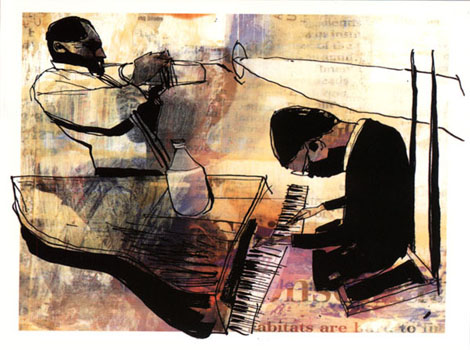 |
| Miles Davis and Herbie Hancock by Dave McKean |
Miles very much supported the idea of taking risks with the music. That's what he wanted us to do. He wanted us to constantly try to work on things, and constantly try to find new ways of expressing ourselves. So he very much encouraged risk-taking. As a matter of fact, he wasn't concerned at all about our mistakes. He was much more concerned about the courage that it takes to make mistakes. When you're on the edge, then you will make "mistakes"; if you're reaching for something, there will be "mistakes"--it's not going to sound so perfect. But it's the search and the honesty and the integrity that people can feel. They can hear it and they can feel it in their hearts. And that is what touches and moves them.
It is my Buddhist practice that is at the core of these realizations that I've had. It has really opened my eyes to things that I have observed and heard from my musical mentors. And I've been able to see how the things I have learned about creating music can be applied to life.
I've learned that any situation can be viewed from an infinite number of vantage points. With Miles I got that through music. I learned that a composition, a tune, a piece of music written by someone, is one example, one expression, of an idea. A jazz musician can take that song and, through the realization that it is an example, can create other examples by looking for other ways to view the piece of music.

That concept can also be applied to daily life. There is a natural tendency for us as human beings to see the situations that happen to us from one vantage point. But what Buddhism teaches us, and what life teaches us, is that a situation can be looked at in many, many different ways. And the way we look at that situation, and how we deal with it as a result of seeing it from other vantage points, can determine whether that life situation is going to have a negative or a positive effect on our future.
There are many things we get exposed to that at the outset appear to be negative, appear to be an obstacle or a problem. "Why did this happen to me?" That kind of reaction. But it is through those challenges that one can develop a strong foundation, deeper roots and an appreciation of one's own ability to overcome obstacles and to grow from them. This gives one a sense of self-worth. We can actually come to appreciate the obstacles themselves, and we can develop a deeper appreciation for our own life. So challenges are really an opportunity to get us closer to freedom. Real freedom is when you're not afraid of any situation that might happen to you in the future.
SGIQ: Can you talk about the relationship between creativity and suffering?
HH: There is a tendency for people to feel that an artist has to suffer, or pay his dues, in order to have a message that can translate as feeling through his art form. I don't deny the importance of having things to deal with in one's life, or how these can be instrumental in stimulating the creative juices. But what I realize at this point is that if you're striving hard to challenge yourself, whether it is through your art form, or whatever kind of job you may have, or with your family, or just the daily life that you live, there is no way you can avoid experiencing suffering to some degree. And it is through these sufferings and challenges that you can not only stimulate the creative juices but also develop a sense of self-sufficiency or autonomy. If you are not confronting such situations, it means either that you're not challenging your life or your art or that you're asleep, sleeping on the job, so to speak.
There is no one who can escape from suffering. Because materialism is so rampant and out of balance today, there's a tendency to think that if you're rich and you have the "right car," the "right job," a spouse or a mate, all those trappings, then you can be happy. When in fact it doesn't work that way. The most valuable qualities of life are priceless; they cannot be bought or sold. And they have more to do with recognizing that you can overcome situations in your life, recognizing that obstacles are the means for growth in your life, with developing compassion and appreciation for the people in your life, for the environment that we live in. Developing courage. There are so many important qualities that give life meaning and beauty and that dwarf that kind of materialistic viewpoint. Of course we all do need to be able to survive in life, but I think things have gone just too far in the materialistic direction.
SGIQ: Technology is often seen as a dehumanizing force in society. Do you think it also has creative possibilities to offer?
HH: As far as I can tell, there haven't been any real attempts to start a movement to explore the possible uses of technology to address the real issues of everyday life, the real problems. Like problems with peer pressure, man's inhumanity toward man, social problems, problems with sexism, problems with drugs, situations to do with sexual identity. All of the real things that people have to deal with in everyday life. I haven't seen anybody really attempt to explore the use of technology for those things. People in the world of technology have a tendency to be dazzled by it. And they think it is really helping the world--"Look how fast things are moving!" But look at the newspapers. Look at the front page, look at the first five pages. How many situations do you see in those first five pages where technology is being used? Generally, the answer is "none" because those possibilities haven't really been explored.
I've been noticing that quite often today you see the word "knowledge" or the word "information," especially in this new technological age. The word that seems to have disappeared from the vocabulary is the word "wisdom." You never see that anymore.
What most concerns me is that the human being is no longer the fulcrum, or the focus of life. It's somewhere low down on the list of priorities. If human happiness is not at the top of our concerns, then none of the other elements will have any meaning. What purpose is there for technology unless it somehow serves the human spirit and our relationship to the environment in which we live?
One of the initiatives that I've started is to explore the use of technology to address these human issues and concerns. I've started a foundation called the Rhythm of Life Foundation that will collect money for individuals and organizations that are doing this. I started to realize, once I embarked on that project, that I needed a means to develop some examples. So we formed the Rhythm of Life Organization (ROLO). Our first project is one we are conducting in the San Francisco Bay Area with the acronym BAYCAT, Bay View-Hunter's Point Center for the Arts and Technology. The idea for this school that we want to build is not only to be able to give young people access to high-end computers but also to teach them programming with the hope of encouraging them to develop software that deals with the issues that they face in everyday life. We want to encourage them to come up with new visions for the use of technology.
If you think about it, the people who built the technological age are now in the process of adapting to the age that they themselves built, whereas people who were born into it don't have to adapt. It comes naturally to them.
SGIQ: Why do you think it is important to work with young people?
HH: In the 1960s, a lot of major changes were instigated by people in their early teens. What they did really changed the world in many ways. I think that in the not-too-distant future, if we are lucky, a very similar kind of revolution can happen globally through the efforts of people in their teens. I am afraid that if something like this does not happen, not only is the future going to be rocky, but it will become more and more dangerous.
One of the things that I have realized is that so many of the problems that people have to face day-to-day are not problems created by the "have-nots." They've been primarily created by the "haves." Because, unlike the have-nots, the haves have been in the position to have that kind of global impact.
To be honest, I consider myself one of the haves. I'm one of the fortunate ones in life, on the planet. But there is a tendency for people who might be considered the haves to think that the have-nots have nothing to bring to the table of life. The haves, with all of their philanthropic intentions, are often coming from a position of arrogance, thinking that they are the only ones who have the capacity to bring anything to the table. There is a tendency for the haves to feel inherently superior to the have-nots, thinking that the have-nots are stupid, not bright enough. But what they don't realize is that it is not the have-nots who have created the problems for the world
What we need is to create a table of life where everyone is encouraged to bring whatever it is that they may have to offer. You can never tell where the next great concepts can come from. It may be from any place on the planet, including those places that are ignored, forgotten or even looked down upon. Unless we provide a means so that everyone may come to the table of life to bring what they have to offer, we can never experience the advantage of their impact in helping move life forward.
Very often the have-nots, in order to survive and overcome, have had to learn certain lessons in life. The haves may need that kind of creativity, wisdom and vision. Part of the undercurrent of ideas for the Rhythm of Life Organization comes from this kind of realization. The fact that on this planet we all need each other. And we need to help put each other in the position to provide the things we all need to move forward together.
Source: SGI Quarterly (April 2001)
Feb 22, 2013
Embracing Age

"The ideal old age might be likened to a magnificent sunset. Just as the deep red of the setting sun holds the promise of a beautiful tomorrow, a life well lived conveys the gift of hope to future generations," writes Daisaku Ikeda, president of the SGI.
Many more people are living longer, and in more and more countries the proportion of younger people in the population is decreasing. This causes fundamental changes in society, making it necessary for us to reassess the way we approach our lives--the journey through birth, aging and death, or "the life course," as some people have termed it. Mutual learning across the generations should mean all of us can live our lives in dignity.
What are the economic and social effects of the changing average age of the population? How can vulnerable groups access their fair share of society's resources? How can we develop medical resources and community services to respond to these changing demographics? Can we ensure that in our cities, towns and villages, the contribution of older people is valued, whilst also improving accessibility of public facilities?
Sadly, despite inspiring attempts to tackle these issues, elder abuse, age discrimination and stereotyping of older adults act as significant barriers to maximizing the potential of all. A movement toward an international Convention on the Rights of Older Persons is now under way, just as there is a Convention on the Rights of the Child. But whether or not the legal instruments are in place, we need to recognize that, in order for old age to be a time of fruition and fulfillment, we need to cherish and love life in all its different aspects and phases. Perhaps only then can we truly develop our inner strength, and--remembering that we too are becoming older--continue to shine brilliantly and advance with ever greater vitality.

Feb 19, 2013
How to Chant
A short film demonstrating how to begin chanting Nam-myoho-renge-kyo, explaining its meaning and introducing the daily Buddhist practice of SGI members around the world.
Source: SGI
Source: SGI
Subscribe to:
Posts (Atom)