
Showing posts with label Buddhist Practice. Show all posts
Showing posts with label Buddhist Practice. Show all posts
Jan 19, 2016

Jul 9, 2014
The Truest Happiness

little Lotus girls by hyamei
Some people tend to think happiness hinges on whether they have enough money, a certain level of education, a successful career, healthy relationships, good looks, good physical health or other external circumstances. They may think, If I just has this one thing, then I'd be happy. But even experiencing one favorable circumstance after another doesn't guarantee happiness. Life includes good and bad times, favorable and challenging circumstances.
The purpose of our Buddhist practice is to help us appreciate every moment of our lives and live bravely, boldly and happily in a world filled with joys, sufferings and everything in between.
This was Nichiren Daishonin's message in this letter to his disciple Shijo Kingo. Kingo had been discouraged by the downpour of hardships and pressures he faced following his unsuccessful efforts to convert his lord, Ema, to Nichiren's teachings. Lord Ema was a supporter of Ryokan, a powerful priest who held great enmity toward Nichiren.
Nichiren explained to Kingo that sufferings are a part of life. But he also assured Kingo that, through his efforts to uphold and spread the Mystic Law, he would experience the "boundless joy of the Law."
In this letter, Nichiren cites a passage from the "Life Span" chapter of the Lotus Sutra: "........where living beings enjoy themselves at ease." This phrase is part of the daily sutra recitation conducted by SGI members, written in the liturgy as shujo sho yu-raku (see Liturgy of Nichiren Buddhism, p. 12). It describes the indestructible life-condition of deep joy and fulfillment we refer to as Buddhahood.
Second Soka Gakkai president Josei Toda explained Buddhahood as the state of "absolute happiness." In strictly encouraging a young woman discouraged by the bleak outlook of her future, President Toda said: "What you think faith is? Are you anxious to live in comfort? Do you want to be flattered by others? Did you convert simply to achieve an outward appearance of happiness? The ultimate objective of Nichiren Daishonin' s Buddhism lies in awakening to your eternal life. This is something you yourself must acquire through your own experience. This attainment is called absolute happiness, because it is indestructible and endures for all eternity. To achieve it, we must continue our faith" (The Human Revolution, p. 323).
He stressed that each person must strive to establish this grand life- state within. In other words, happiness is not dependent on external circumstances or other people. It is solely dependent on our own efforts and awakening. The relative or temporary joy that comes from fulfilling a particular desire is not comparable to the profound state of life achieved through taking actions based on the Mystic Law. Such momentary joy fades with the dimming of the desire and may be called "relative happiness." The "boundless joy of the law" lasts for an eternity and equates to "absolute happiness."
SGI President Ikeda says: "True happiness is not feeling happiness one moment and then misery the next. Rather, overcoming the tendency to blame our sufferings on others or on the environment enables us to greatly expand our state of life." (Learning from the Gosho: The Eternal Teachings of Nichiren Daishonin, p. 237).
When we chant Nam Myoho Renge Kyo, we fuse our lives with the Mystic Law. At the same time, we are battling the inner darkness that prevents this fusion from taking place. When we overpower this darkness of delusion of ignorance and fuse our lives with the Mystic Law, we can experience its unlimited power in our lives. Chanting is the greatest cause to reveal Buddhahood in our lives. Therefore, Nichiren says, "There is no true happiness for human beings other than chanting Nam Myoho Renge Kyo."
President Toda described the expansive state of life we gain through Buddhist practice as follows: "It is like lying sprawled on your back in a wide-open space looking up at the sky. All that you wish for immediately appears. No matter how much you may give away, there is always more. It is never exhausted" (Lectures on "Attaining Buddhahood in this Lifetime," p. 35).
Through persisting in our SGI activities to practice and spread Nichiren Buddhism, we can bring forth the wisdom, courage, hope and joy to conquer even the most severe problems. We can feel at "at ease" and find the peace of mind regardless of our circumstances. Buddhism teaches us that experiencing difficulties allows us to treasure happiness. And both suffering and joy are necessary to truly understand the deeper significance of our existence. As long as we continue to chant Nam Myoho Renge Kyo, working for our own happiness and that of others, we establish at fundamental core of our lives the greatest causes for attaining Buddhahood in this lifetime.
World Tribune- Feb 2009
Jul 3, 2014
Source of Victory

~ Living Buddhism 2012
Mar 13, 2013
Good Friends

Ananda, one of Shakyamuni Buddha's closest disciples, once asked him: "It seems to me that by having good friends and advancing together with them, one has already halfway attained the Buddha way. Is this way of thinking correct?"
Shakyamuni replied, "Ananda, this way of thinking is not correct. Having good friends and advancing together with them is not half the Buddhist way but all the Buddhist way."
This may seem surprising, as Buddhism is often viewed as a solitary discipline in which other people might be seen as more of a hindrance than a help. However, to polish and improve our lives ultimately means to develop the quality of our interpersonal relationships--a far more challenging task than any solitary discipline. Our practice of Buddhism only finds meaning within the context of these relationships.
From another perspective, given that Buddhist practice of polishing and aiming to improve our lives from within is a constant challenge and a difficult process, it is only natural that we need support from others also dedicated to walking a correct path in life, trying also to create value in their lives.
SGI President Daisaku Ikeda has written, "Having good friends is like being equipped with a powerful auxiliary engine. When we encounter a steep hill or an obstacle, we can encourage each other and find the strength to keep pressing forward." And as Nichiren (1222--1282) wrote: "Even a feeble person will not stumble if those supporting him are strong, but a person of considerable strength, when alone, may lose his footing on an uneven path . . ."
In Nichiren Buddhism, good friends are known as zenchishiki or good influences, while akuchishiki refers to bad influences. People affect each other in subtle and complex ways, and it is important to develop the ability to discern the nature of that influence. According to Buddhism, "bad" friends are those who encourage our weaknesses. In Nichiren's words: "Evil friends are those who, speaking sweetly, deceiving, flattering and making skillful use of words, win the hearts of the ignorant and destroy their goodness of mind."

Even when intentions are good, the degree of our positive influence on each other will vary. Tsunesaburo Makiguchi, founder of the Soka Gakkai, used the following illustration. Say you have a friend who needs a certain amount of money. Giving your friend the money they need is an act of small good, while helping them find a job is an act of medium good. However, if your friend is really suffering because of a basic tendency toward laziness, then constantly helping him or her out may only perpetuate negative habits. In this case, true friendship is helping that person change the lazy nature that is the deep cause of their suffering.
A truly good friend is someone with the compassion and courage to tell us even those things we would prefer not to hear, which we must confront if we are to develop and grow in our lives.
Ultimately, however, whether people are good or evil influences in our lives is up to us. In Buddhist terms, the best kind of zenchishiki is one who leads us to strengthen our own faith and practice in order to thoroughly transform our karma. To quote Nichiren again, "the best way to attain Buddhahood is to encounter a zenchishiki, or good friend." Further, Nichiren comments that Devadatta, the cousin of Shakyamuni who tried to kill him and divide the Buddhist order, was "the foremost good friend to Thus Come One Shakyamuni. In this age as well, it is not one's allies, but one's powerful enemies who assist one's progress."
This expresses a key concept in Buddhism. Due to the immense transformative powers of Buddhist practice, even "bad" friends can have a good influence if we make our relationships with them into opportunities to examine, reform and strengthen our lives. The ideal is ultimately to develop the kind of all-encompassing compassion expressed by Nichiren when he wrote that his first desire was to lead to enlightenment the sovereign who had persecuted him, repeatedly exiling and even attempting to behead him.
Source: SGI Quarterly
Mar 5, 2013
Desires and Enlightenment

"The teachings of Nichiren stress the transformation, rather than the elimination, of desire. Desires and attachments are seen as fueling the quest for enlightenment. As he wrote: 'Now Nichiren and others who chant Nam-myoho-renge-kyo... burn the firewood of earthly desires and behold the fire of enlightened wisdom.'"
People encountering Nichiren Buddhism for the first time are often surprised by the stance taken toward desire which seems to contradict prevailing images of Buddhism. For many, Buddhism is associated with asceticism, and indeed there are many schools and traditions which stress the need to eliminate desire and sever all attachments.
Needless to say, a life controlled by desires is miserable. In Buddhist scriptures, such a way of life is symbolized by "hungry demons" with giant heads and huge mouths, but narrow, constricted throats that make real satisfaction unattainable. The deliberate horror of these images grew from Shakyamuni Buddha's sense of the need to shock people from their attachment to things--including our physical existence--that will eventually change and be lost to us. Real happiness does not lie here, he sought to tell them.
The deeply ingrained tendencies of attachments and desire (Jpn bonno) are often referred to by the English translation "earthly desires." However, since they also include hatred, arrogance, distrust and fear, the translation "deluded impulses" may in some cases be more appropriate.
But can such desires and attachments really be eliminated? Attachments are, after all, natural human feelings, and desires are a vital and necessary aspect of life. The desire, for example, to protect oneself and one's loved ones has been the inspiration for a wide range of advances--from the creation of supportive social groupings to the development of housing and heating. Likewise, the desire to understand humanity's place in the cosmos has driven the development of philosophy, literature and religious thought. Desires are integral to who we are and who we seek to become.
In this sense, the elimination of all desire is neither possible nor, in fact, desirable. Were we to completely rid ourselves of desire, we would end up undermining our individual and collective will to live.
The teachings of Nichiren thus stress the transformation, rather than the elimination, of desire. Desires and attachments are seen as fueling the quest for enlightenment. As he wrote: "Now Nichiren and others who chant Nam-myoho-renge-kyo...burn the firewood of earthly desires and behold the fire of enlightened wisdom..."
In the same vein, the Universal Worthy Sutra states: "Even without extinguishing their earthly desires or denying the five desires, they can purify all of their senses and eradicate all of their misdeeds."
Nichiren's approach has the effect of popularizing, humanizing and democratizing Buddhism. In other words, by making the aspirations, dreams and frustrations of daily life the "fuel" for the process of enlightenment, Nichiren opens the path of Buddhist practice to those who had traditionally been excluded by the demands of a meditative withdrawal from the world--those, for example, who wish to continue playing an active role in the world.
It is thus not a coincidence that this attitude toward desires should be central to the Mahayana tradition of Buddhism, with its emphasis on the role of lay practitioners. For people living in the midst of ever-changing, stressful realities, those challenges are a far more effective spur to committed Buddhist practice than an abstract goal of "enlightenment" through severing of all desires and attachments.
Overcoming problems, realizing long-cherished goals and dreams--this is the stuff of daily life from which we derive our sense of accomplishment and happiness. SGI President Daisaku Ikeda has emphasized the importance not of severing our attachments, but of understanding and, ultimately, using them.
Often the faith experiences of SGI members describe events and changes that seem at first glance to be focused on the external, material side of life. But such "benefits" are only part of the story. Buddhism divides the benefits of practice into the "conspicuous" and the "inconspicuous." The new job, the conquest of illness, the successful marriage and so on are not separate from a deep, often painstaking process of self-reflection and inner-driven transformation. And the degree of motivation generated by desires can lend an intensity to our practice which ultimately reaps spiritual rewards. Bonno soku bodai--literally, "Earthly desires are enlightenment"--is a key tenet of Nichiren Buddhism.
Through our Buddhist practice, even the most mundane, deluded impulse can be transformed into something broader and more noble, and our desires quite naturally develop from self-focused ones to broader ones concerning our families, friends, communities and, ultimately, the whole world.
In this way, the nature of desire is steadily transformed--from material and physical desires to the more spiritually oriented desire to live the most fulfilling kind of life.
As President Ikeda says: "I believe in the existence of another kind of human desire: I call it the basic desire, and I believe that it is the force that actively propels all other human desires in the direction of creativity. It is the source of all impelling energy inherent in life; it is also the longing to unite one's life with the life of the universe and to draw vital energy from the universe."
Source: SGI Quarterly 2000
Feb 25, 2013
The Art of Life: Interview with Herbie Hancock

In the 1970s, Hancock's use of electronic keyboard instruments helped pioneer the development of jazz-rock and other fusion styles. Since then, as a creative innovator and explorer of new directions in music, he has continued to break new ground in jazz as well as recording a number of popular hits. His 1974 album, Headhunters, is one of the largest-selling jazz albums of all time. In 1986 he won an Oscar for his score for the film 'Round Midnight, in which he also had an acting role.
Hancock began practicing Buddhism and joined the SGI in 1972.
The SGI Quarterly interviewed Hancock about his experience of living a creative life.
SGI Quarterly: Can you talk about what it means to live a creative life?
Herbie Hancock: At this point in my life, my primary focus is not on the art form that my career has been built around to date. What I focus on primarily is the real source--or the purpose--that my art form, music, is about. That is, life itself.
At the foundation of artistic expression is the very core of life. So what I'm finding is that the more I attempt to expand and develop my life, the greater the impact is on my music. Music becomes a tool for that expression. My focus is to practice this particular art form with the hope that ultimately it will be a catalyst in the listeners' appreciation of their own lives. My hope is not particularly that the audience will be inspired by my music and put me on a pedestal. That's not what it's about. I hope that somehow it triggers something within themselves where they feel that their life has more meaning, substance and inspiration. That they become more aware of something that is already in them.
That's the hope. And I think that where one is "coming from" is extremely important. Your vision for that pathway, your intention, is very important.
SGIQ: There seems to be a big distance between what you are saying and the general understanding of creative talent, or genius.
HH: There is a tendency for people to be very forgiving about the attitude of the artist, as long as the artistic expression pleases them. They almost expect an artist to be a little weird and a little egotistical, rude. But I'm very much against that. One very strong realization that I have at this point is that the most important art is one everyone is involved in, the art of living. And that is the most difficult one, the most important one to master and develop. And so everyone is an artist in that sense. This really helps me in my own appreciation of the lives of others.
SGIQ: What did you learn working with great masters like Miles Davis?
HH: I've been speaking pretty generally, but to be specific, there are certain characteristics that I strive to be aware of as being very important, and one of them is risk-taking. But, I have to add, with a sense of responsibility. Without a sense of responsibility you can get yourself in a lot of trouble taking risks.
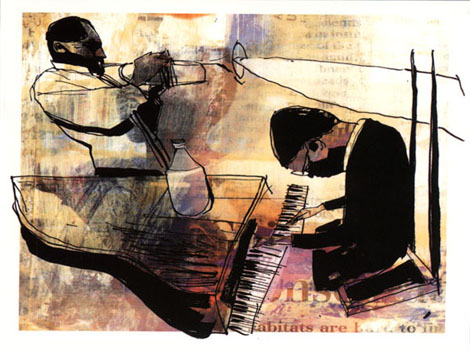 |
| Miles Davis and Herbie Hancock by Dave McKean |
Miles very much supported the idea of taking risks with the music. That's what he wanted us to do. He wanted us to constantly try to work on things, and constantly try to find new ways of expressing ourselves. So he very much encouraged risk-taking. As a matter of fact, he wasn't concerned at all about our mistakes. He was much more concerned about the courage that it takes to make mistakes. When you're on the edge, then you will make "mistakes"; if you're reaching for something, there will be "mistakes"--it's not going to sound so perfect. But it's the search and the honesty and the integrity that people can feel. They can hear it and they can feel it in their hearts. And that is what touches and moves them.
It is my Buddhist practice that is at the core of these realizations that I've had. It has really opened my eyes to things that I have observed and heard from my musical mentors. And I've been able to see how the things I have learned about creating music can be applied to life.
I've learned that any situation can be viewed from an infinite number of vantage points. With Miles I got that through music. I learned that a composition, a tune, a piece of music written by someone, is one example, one expression, of an idea. A jazz musician can take that song and, through the realization that it is an example, can create other examples by looking for other ways to view the piece of music.

That concept can also be applied to daily life. There is a natural tendency for us as human beings to see the situations that happen to us from one vantage point. But what Buddhism teaches us, and what life teaches us, is that a situation can be looked at in many, many different ways. And the way we look at that situation, and how we deal with it as a result of seeing it from other vantage points, can determine whether that life situation is going to have a negative or a positive effect on our future.
There are many things we get exposed to that at the outset appear to be negative, appear to be an obstacle or a problem. "Why did this happen to me?" That kind of reaction. But it is through those challenges that one can develop a strong foundation, deeper roots and an appreciation of one's own ability to overcome obstacles and to grow from them. This gives one a sense of self-worth. We can actually come to appreciate the obstacles themselves, and we can develop a deeper appreciation for our own life. So challenges are really an opportunity to get us closer to freedom. Real freedom is when you're not afraid of any situation that might happen to you in the future.
SGIQ: Can you talk about the relationship between creativity and suffering?
HH: There is a tendency for people to feel that an artist has to suffer, or pay his dues, in order to have a message that can translate as feeling through his art form. I don't deny the importance of having things to deal with in one's life, or how these can be instrumental in stimulating the creative juices. But what I realize at this point is that if you're striving hard to challenge yourself, whether it is through your art form, or whatever kind of job you may have, or with your family, or just the daily life that you live, there is no way you can avoid experiencing suffering to some degree. And it is through these sufferings and challenges that you can not only stimulate the creative juices but also develop a sense of self-sufficiency or autonomy. If you are not confronting such situations, it means either that you're not challenging your life or your art or that you're asleep, sleeping on the job, so to speak.
There is no one who can escape from suffering. Because materialism is so rampant and out of balance today, there's a tendency to think that if you're rich and you have the "right car," the "right job," a spouse or a mate, all those trappings, then you can be happy. When in fact it doesn't work that way. The most valuable qualities of life are priceless; they cannot be bought or sold. And they have more to do with recognizing that you can overcome situations in your life, recognizing that obstacles are the means for growth in your life, with developing compassion and appreciation for the people in your life, for the environment that we live in. Developing courage. There are so many important qualities that give life meaning and beauty and that dwarf that kind of materialistic viewpoint. Of course we all do need to be able to survive in life, but I think things have gone just too far in the materialistic direction.
SGIQ: Technology is often seen as a dehumanizing force in society. Do you think it also has creative possibilities to offer?
HH: As far as I can tell, there haven't been any real attempts to start a movement to explore the possible uses of technology to address the real issues of everyday life, the real problems. Like problems with peer pressure, man's inhumanity toward man, social problems, problems with sexism, problems with drugs, situations to do with sexual identity. All of the real things that people have to deal with in everyday life. I haven't seen anybody really attempt to explore the use of technology for those things. People in the world of technology have a tendency to be dazzled by it. And they think it is really helping the world--"Look how fast things are moving!" But look at the newspapers. Look at the front page, look at the first five pages. How many situations do you see in those first five pages where technology is being used? Generally, the answer is "none" because those possibilities haven't really been explored.
I've been noticing that quite often today you see the word "knowledge" or the word "information," especially in this new technological age. The word that seems to have disappeared from the vocabulary is the word "wisdom." You never see that anymore.
What most concerns me is that the human being is no longer the fulcrum, or the focus of life. It's somewhere low down on the list of priorities. If human happiness is not at the top of our concerns, then none of the other elements will have any meaning. What purpose is there for technology unless it somehow serves the human spirit and our relationship to the environment in which we live?
One of the initiatives that I've started is to explore the use of technology to address these human issues and concerns. I've started a foundation called the Rhythm of Life Foundation that will collect money for individuals and organizations that are doing this. I started to realize, once I embarked on that project, that I needed a means to develop some examples. So we formed the Rhythm of Life Organization (ROLO). Our first project is one we are conducting in the San Francisco Bay Area with the acronym BAYCAT, Bay View-Hunter's Point Center for the Arts and Technology. The idea for this school that we want to build is not only to be able to give young people access to high-end computers but also to teach them programming with the hope of encouraging them to develop software that deals with the issues that they face in everyday life. We want to encourage them to come up with new visions for the use of technology.
If you think about it, the people who built the technological age are now in the process of adapting to the age that they themselves built, whereas people who were born into it don't have to adapt. It comes naturally to them.
SGIQ: Why do you think it is important to work with young people?
HH: In the 1960s, a lot of major changes were instigated by people in their early teens. What they did really changed the world in many ways. I think that in the not-too-distant future, if we are lucky, a very similar kind of revolution can happen globally through the efforts of people in their teens. I am afraid that if something like this does not happen, not only is the future going to be rocky, but it will become more and more dangerous.
One of the things that I have realized is that so many of the problems that people have to face day-to-day are not problems created by the "have-nots." They've been primarily created by the "haves." Because, unlike the have-nots, the haves have been in the position to have that kind of global impact.
To be honest, I consider myself one of the haves. I'm one of the fortunate ones in life, on the planet. But there is a tendency for people who might be considered the haves to think that the have-nots have nothing to bring to the table of life. The haves, with all of their philanthropic intentions, are often coming from a position of arrogance, thinking that they are the only ones who have the capacity to bring anything to the table. There is a tendency for the haves to feel inherently superior to the have-nots, thinking that the have-nots are stupid, not bright enough. But what they don't realize is that it is not the have-nots who have created the problems for the world
What we need is to create a table of life where everyone is encouraged to bring whatever it is that they may have to offer. You can never tell where the next great concepts can come from. It may be from any place on the planet, including those places that are ignored, forgotten or even looked down upon. Unless we provide a means so that everyone may come to the table of life to bring what they have to offer, we can never experience the advantage of their impact in helping move life forward.
Very often the have-nots, in order to survive and overcome, have had to learn certain lessons in life. The haves may need that kind of creativity, wisdom and vision. Part of the undercurrent of ideas for the Rhythm of Life Organization comes from this kind of realization. The fact that on this planet we all need each other. And we need to help put each other in the position to provide the things we all need to move forward together.
Source: SGI Quarterly (April 2001)
Mar 29, 2011
Challenging our Weakness
Challenging our weakness
is the key to believing in ourselves
By Linda C. Johnson, SGI-USA Vice General Director, Los Angeles (from Living Buddhism, January 2003)
It was as a result of my fervent prayer that I realized I would never be able to write anything as long as I permitted myself to hold on to the doubt in my ability to write an article that would encourage others. I turned to “Reply to Kyo’o,” one of my favorite writings by Nichiren Daishonin. In it, the Daishonin tells us: “Believe in this mandala with all your heart. Nam-myohorenge-kyo is like the roar of a lion. What sickness can therefore be an obstacle?” (The Writings of Nichiren Daishonin, p. 412).

President Ikeda explains: “The strength of our mind of faith changes suffering into joy, into a tailwind to propel our further advance. This is what the ‘Devadatta’ chapter teaches. Nichiren Daishonin says: ‘Devadatta was the foremost good friend to the Thus Come One Shakyamuni. In this age as well, it is not one’s allies but one’s powerful enemies who assist one’s progress’ (WND, 770).

This state of happiness is also greatly enhanced through our efforts to help others. I continually find that whenever I do my best to encourage another person in faith, no matter how I am feeling, my life-condition is positively transformed. Giving to others expands our own lives in wonderful, sometimes unimaginable ways.
In this regard, I must mention that I have recently met many members who are stuck in what I call a maintenance practice. They are comfortable, even if it means being comfortable with being uncomfortable. They have lost their seeking spirit, the will to seek out challenges. They have no personal goals. This is a dangerous condition because, from my own experience, it robs us of our passion and enthusiasm for life. We are not even aware of what is happening at first. By the time we are conscious that our lives are missing something, our apathy has become highly developed, and it seems almost impossible to change.
Success is triumphing over challenges. We must challenge ourselves to
do everything
we think we cannot do. Only then will we truly come to know that we
have nothing
to fear because, with the Mystic Law as our foundation, we can
transform any
weakness into strength. That being so, I think you and I are perfect
just the
way we are.
By Linda C. Johnson, SGI-USA Vice General Director, Los Angeles (from Living Buddhism, January 2003)
“I had to ask myself whether I truly believed in the power of my
prayer
to break through my own fears and insecurities.”
I want to unconditionally love myself. I want to embrace every part
of me.
I want to believe, without reservation, that my life is
Nam-myohorenge-kyo itself.
My challenge is to believe these things amidst the realities of my
daily life.
It is a struggle, I believe, all of us face every day.
As I prepared to write this article, my deepest insecurities and
fears emerged.
I wondered: “What could I say that will inspire someone?” I bathed
in those feelings; they enveloped me. As a consequence, I could not
write a
single word. I turned to prayer, chanting to be able to write an
article that
would encourage others and help them break through the deadlocks in
their lives.
But my doubts lingered. I fought them continuously, during the day
whenever
they arose, as well as when I sat chanting in front of the Gohonzon.
In spite
of how I was feeling, I poured my entire life into encouraging others
during
meetings and guidance sessions. I told them that, with faith, they had
the power
to do anything. In the meantime, I remained stuck.
It was as a result of my fervent prayer that I realized I would never be able to write anything as long as I permitted myself to hold on to the doubt in my ability to write an article that would encourage others. I turned to “Reply to Kyo’o,” one of my favorite writings by Nichiren Daishonin. In it, the Daishonin tells us: “Believe in this mandala with all your heart. Nam-myohorenge-kyo is like the roar of a lion. What sickness can therefore be an obstacle?” (The Writings of Nichiren Daishonin, p. 412).
I had to ask myself whether I truly believed in the power of my
prayer to break
through my own fears and insecurities. I prayed sincerely to trust
what Nichiren
Daishonin was telling me. I also prayed to have unshakeable confidence
that,
with prayer as my foundation, I could overcome my doubts and write an
inspiring
article. My doubt, however, did not disappear instantly. There were
times while
I was chanting that it felt as if every cell in my body wanted to run
away.
The television was calling me. The telephone was ringing. I had chores
to do.
I returned to “Reply to Kyo’o”: “A sword is useless
in the hands of a coward. The mighty sword of the Lotus Sutra must be
wielded
by one courageous in faith. Then one will be as strong as a demon
armed with
an iron staff. I, Nichiren, have inscribed my life in sumi ink, so
believe in
the Gohonzon with your whole heart” (WND, 412).
This was my answer. I had to muster the courage to confront my fear.
No matter
how painful my current situation, I could not back down. For days, I
continued
to challenge my insecurity with prayer while immersing myself in
activities
to help others overcome their problems. Then, the day before I was
scheduled
to submit my article, I had my breakthrough. I had finally understood
why I
had been going through so much agony. The issue wasn’t the article. I
needed to confront my own doubt, my own lack of belief in my inherent
power
to challenge and win over my fears and insecurities.
Whether we are writing an article, facing illness, being terminated
from a
job or looking for our soul mate, the process is the same. We must
transform
our weaknesses into strengths. We must face our suffering and triumph
over it.
This experience became the catalyst for me to explain how one uses
faith to
transform challenging daily life situations into an uncompromising
opportunity
for growth. This, I believe, is the essence of the concept of the
oneness of
good and evil.

Nichiren Buddhism makes it clear that everything and everyone in life
has both
a good and an evil side. I know that some people have an immediate
negative
response to the word evil. Evil also is synonymous with the words
selfishness
and self-centeredness. Life at every moment is a battle between these
two opposing
forces of good and evil. In other words, when we manifest our
Buddhahood, it
does not mean that our self-centeredness goes away. Instead, our
ability to
continue to uncover more of our potential is directly related to our
ability
to create value using the self-centered side, rather than allowing it
to affect
us negatively. In other words, the impact that our own
self-centeredness or
that of others will have on us is based on our response to it.
In Webster’s New World Dictionary, one of the definitions of respond
is “to have a positive or favorable reaction.” This definition accords
with Nichiren Buddhism, the Buddhism of true cause. We cannot change
the past.
In this moment, however, with our thoughts, words, and actions, we are
creating
our future. In this moment, through our actions, we have the
opportunity to
change anything and everything. Isn’t that the meaning of true cause?
We affect change by how we respond to our circumstances. For example,
rather
than an automatic negative response to difficult circumstances, we
must, like
the definition, “have a positive or favorable reaction” in order
to create the outcome we are seeking.
Many of us think that if we don’t do anything the problem will just
go
away on its own. This is not the case. Even if it seemingly goes away
temporarily,
it comes back bigger and stronger.
President Ikeda explains: “The strength of our mind of faith changes suffering into joy, into a tailwind to propel our further advance. This is what the ‘Devadatta’ chapter teaches. Nichiren Daishonin says: ‘Devadatta was the foremost good friend to the Thus Come One Shakyamuni. In this age as well, it is not one’s allies but one’s powerful enemies who assist one’s progress’ (WND, 770).
To attain Buddhahood, we have to thoroughly conquer our own inner
evil. The
concrete means for doing so is struggling against and defeating
external evil.
Struggling to defeat evil enables us to polish and purify our lives
and attain
Buddhahood. Because we strive against the ultimate evil, we attain the
ultimate
good” (The Wisdom of the Lotus Sutra, vol. III, p. 84).
In other words, the oneness of good and evil means that where evil
exists,
there is the potential for good, and where good exists, there is the
potential
for evil. Whether evil is transformed into something good is totally
dependent
upon our reaction to evil. Do we use our circumstances as
a justification for
our failure, or do we use our circumstances as an opportunity to
develop our
strength? When we challenge evil with the spirit that we will create
something
of value out of it, then evil functions to propel us forward. It
becomes the
catalyst for our growth. “If evil functions to reveal good, then evil
in its entirety becomes good. This is truly the oneness of good and
evil. But
if evil is simply allowed to run its course, then it does not become
good. Only
when evil is thoroughly challenged and conquered does it become an
entity of
the oneness of good and evil” (The Wisdom of the Lotus Sutra, vol.
III,
p. 83).
 |
| Art by Seleus |
In addition to our individual lives, this principle also applies to
the situation
we are facing with Nichiren Shoshu. We live during a historic time, a
time when
we have the opportunity to prove the correctness of Nichiren Buddhism
by the
way we respond. Nikken is changing Nichiren’s teachings by
proclaiming,
for example, that people can only attain enlightenment by going
through him.
Are we going to permit Nikken to change the teachings, or are we,
through our
efforts, going to ensure that everyone has the opportunity to practice
Buddhism
correctly as taught by Nichiren? Are we going to prove that Nikken is
wrong
by showing the undeniable growth of the lives of SGI members
throughout the
world?
Happiness, from the perspective of Nichiren Buddhism, is not a state
of life
in which there are no problems. Instead, happiness is to be found in
challenging
and winning over our problems. I believe that the happiness we seek is
the feeling
that occurs whenever we cross that finish line, in spite of the fact
that our
heart is pounding, our feet hurt, and our lungs feel as if they are
about to
explode. That feeling of triumph against all odds is a state of pure
joy that
no one can give us, no matter how much they might love us. It is a
state that
we can achieve only through our own efforts.

This state of happiness is also greatly enhanced through our efforts to help others. I continually find that whenever I do my best to encourage another person in faith, no matter how I am feeling, my life-condition is positively transformed. Giving to others expands our own lives in wonderful, sometimes unimaginable ways.
We must, therefore, perfect our practice for ourselves and for
others. Both
aspects are essential parts of our practice. Not only must we
challenge our
own weaknesses, we must use our lives to help others win. For example,
do we
take the responsibility to help our friends in faith have a victory?
Do we pray
to make this happen? Maximum growth requires that we perfect both
parts of our
practice.
In this regard, I must mention that I have recently met many members who are stuck in what I call a maintenance practice. They are comfortable, even if it means being comfortable with being uncomfortable. They have lost their seeking spirit, the will to seek out challenges. They have no personal goals. This is a dangerous condition because, from my own experience, it robs us of our passion and enthusiasm for life. We are not even aware of what is happening at first. By the time we are conscious that our lives are missing something, our apathy has become highly developed, and it seems almost impossible to change.
There is no neutral gear in life. We are either going forward or
backward at
every moment. We need goals. They make us alive and deepen our
understanding
of this Buddhism. After all, how can we see change if there is no
standard by
which to measure growth? Challenging and achieving goals are the means
we use
to prove to ourselves as well as to others the power of the Mystic
Law.
I believe that the challenge facing every human being is the ability
to truly
love and believe in oneself. What I have learned as a result of facing
my insecurities
and fears during the process of writing this article is that I do not
need to rid myself of weakness. Instead, I must train myself to learn how to use it as my motivation to create positive change in my life. The power to make this possible is sincere prayer based on a powerful determination. Prayer makes what we normally would consider impossible into something possible.
need to rid myself of weakness. Instead, I must train myself to learn how to use it as my motivation to create positive change in my life. The power to make this possible is sincere prayer based on a powerful determination. Prayer makes what we normally would consider impossible into something possible.
I’m sure you are all familiar with the song “Wind Beneath My Wings.”
Negativity self-centered-ness and obstacles can be the wind beneath
our wings
that propels us to soar even higher. Viewing challenges this way may
require
rethinking the way we live our lives. I am convinced, however, that
living this
way is the key to experiencing a joyflul, fulfilled existence; one in
which we
will come to know and believe that Nam myoho-renge-kyo is life itself.
Mar 27, 2011
Faith and Attitude
Written by By SGI-UK Advisor Mitsuhiro Kaneda, UK Express March 2000
Today I’d like to talk to you about how to make your prayers
as effective as possible.
Firstly, it is very important to set clear goals. If you are sick, your goal will be to get better as quickly as possible; if you have problems with human relationships, you will want to get over these as soon as possible; and if you have financial difficulties, then of course you should be setting goals accordingly.
Once you have decided on the goal, the most important thing to do next is make a strong determination: ‘Whatever happens, I absolutely will attain that goal’. A firm determination like this is very important. The next stage, of course, is prayer. And after chanting daimoku, the next step necessary is to take action in order to realize your goal. Of course, after we’ve done all that, we know what the effect will be: actual proof. If we do not achieve the goal we have set then, in certain cases, we may need to review the determination, set a new goal, and once again strive to achieve it.
Why we need to pray
There are three reasons why we should pray. Firstly, so we can have the same wisdom as the Buddha. Secondly, so that we can have life-force, in other words the energy, the courage, to take action. Thirdly, so that we can benefit from the protection of the shoten zenjin, the Buddhist ‘gods’, the protective functions within the universe.
One point I’d like to make sure that you really understand, is that the shoten zenjin only start to take action and protect us when we ourselves undertake action. So, in order for us to achieve a goal, we need to act. We need to move. We need to make efforts. And it is important that our actions and our efforts are the best we can possibly undertake. To ensure that our actions and efforts are efficient, we need wisdom. Furthermore, if we are to attain the goal we have set ourselves, we need to make constant efforts – and we also need courage.

So we pray to the Gohonzon to have the wisdom to take the best, most efficient action possible; to have the life-force to make constant efforts; and to attract the protection of the shoten zenjin when we take an action. However, even if we chant ever so hard, it will be very difficult to boil that pot of spaghetti unless we take action. And to make sure that we not only boil the spaghetti, but that it is al dente, we need wisdom and we need experience.
Quality of prayer
The quality of our prayer is also extremely important. For example, someone who is sick may simply pray to overcome their illness. Or they may pray to regain their health in order to fight for kosen rufu. There is a very big difference between these two types of prayer.
The quality of our prayer is also extremely important. For example, someone who is sick may simply pray to overcome their illness. Or they may pray to regain their health in order to fight for kosen rufu. There is a very big difference between these two types of prayer.
To take another example, suppose there’s a couple who have been unable to have children, despite trying for a long time. While they may be chanting to have a child as soon as possible, what are their reasons for wanting a child? Are their reasons purely personal, because it would make them happy, because they want to have children? Or are they chanting to have a child do that they can bring this child up to become someone who will be a capable person for kosen rufu? There is a huge difference between these two in terms of quality of prayer.
The reason it is very important for us to focus on the quality of our prayer is that President Ikeda has said that true and sincere prayers for kosen rufu (not prayers aimed dimply at justifying our own point of view) will be answered without fail.
Taking action
Very often, however, members chant a lot of daimoku but do not take any action. Some people don’t take action because they are afraid of the results they might see. They are afraid that they won’t see the result they want, so they don’t take any action. For example, a salaried employee with a fixed income might want to become self-employed, or start his or her own business, but might not take any action for fear of accumulating a lot of debt.
Very often, however, members chant a lot of daimoku but do not take any action. Some people don’t take action because they are afraid of the results they might see. They are afraid that they won’t see the result they want, so they don’t take any action. For example, a salaried employee with a fixed income might want to become self-employed, or start his or her own business, but might not take any action for fear of accumulating a lot of debt.
Another common example is found amongst young people who want to get married. Because they’re not sure that the marriage will work out, and that they will live happily ever after, they are full of anxiety. So, before they get married, they think, “Well, maybe we should live together.” Some end up not getting married as a result of having lived together.
So, even when people chant a lot of daimoku, other factors such as personality and human character come into play and prevent people from taking action, even if they are praying.
Of course, taking action also includes Soka Gakkai activities. When you participate in Soka Gakkai activities, you are encouraging others. So you are actually working as a messenger of the Buddha. Inevitably, therefore, all those who participate in Gakkai activities will accumulate good fortune. And because these people accumulate good fortune, they will be able to achieve their goals and show actual proof.
I know that all of us have very different circumstances and situations – some of us may not have that much free time. Nevertheless, I really want to encourage all of you to participate in Gakkai activities because this will allow not only you, but your whole family, to be bathed in good fortune. So in order to achieve our goals, not only do we need to take concrete action, we also need good fortune. That is why Soka Gakkai activities are crucial.

Make up your mind
In Italy, we have a couple who have been living together for fourteen years. Once they came to me because they wanted to receive guidance. I said to them, “You’ve been trying out your relationship by living together for fourteen years now. The fact that it has continued this long, is this not a sign that it is working?
Even though their relationship had been successful and they still wanted to live together, they still weren’t sure whether they should get married. Of course I gave them all kinds of encouragement, but there is one particular point that I would like to share with you. I asked them, “In order to make a firm determination, how much time do you need?” To make a determination requires less than one second. So I asked, “How many seconds there have been in fourteen years?”
You may laugh at this story but please, reflect on your own life.
To sum up, to put Nichiren Daishonin’s Buddhism into practice, we need to decide, chant and take action.
FAITH AND PRACTICE DOUBT-FREE FAITH
DECIDE
DECIDE
Clarify the goal and make a determination
DECIDE CHANT CHANT
If you have a problem,
Chant one million daimoku
If you have a problem,
Chant one million daimoku
ACT ACT
Make maximum effort;
strive to resolve the problem
Make maximum effort;
strive to resolve the problem
EXPERIENCE
Accumulating experiences deepens one’s faith
Theories without experiences are
no more than pure idealism
Accumulating experiences deepens one’s faith
Theories without experiences are
no more than pure idealism
RESULT
Show actual proof DON’T DOUBT
Faith means having no doubts
BELIEVEShow actual proof DON’T DOUBT
Faith means having no doubts
Nov 16, 2010
Which Way Are You Practicing?
Vice President Karwei's Guidance, 1996
Prayers need to have a specific focus. Just chanting daimoku does not constitute prayer with desired results. Prayers equal practice. It means to pray specifically for what you want, by when, and by what means. If you chant for specific results, you will achieve them. If you are putting in half-hearted efforts, it is like taking a walk with no objective or destination in mind and returning home with nothing achieved. Just praying and having aimless actions won’t end in results. You must have specific goals in mind and then take action. This is the correct method.

Lateral-moving practice- people who are practicing out of obligation.
Reverse-moving practice- people who are practicing with suspicion, complaint and negativity.
The people who are moving forward will continue to progress and grow. The people who are moving sideways are moving in circles. The people who are moving backwards will continue to regress and eventually quit the practice.

Prayers need to have a specific focus. Just chanting daimoku does not constitute prayer with desired results. Prayers equal practice. It means to pray specifically for what you want, by when, and by what means. If you chant for specific results, you will achieve them. If you are putting in half-hearted efforts, it is like taking a walk with no objective or destination in mind and returning home with nothing achieved. Just praying and having aimless actions won’t end in results. You must have specific goals in mind and then take action. This is the correct method.

The clear objectives of desiring to change one’s self, heart,
lifestyle,
environment, problems, etc., are important. Nichiren Daishonin says
one must
reflect to see if he or she is advancing or regressing . If one is not
aware,
then they are lazy and may be considered taiten (not practicing). You
could
be exerting yourself but if you are not advancing, then you are
considered to
be in a non-practicing state (taiten). You are practicing to change
yourself,
not just to practice hard. If you haven’t experienced much change in
yourself,
you have not made enough effort to do so. If you just logically study
and understand
this Buddhism, you will not change. Sensei always says, “The heart is
the most important. No one says just try hard. You can make a change,
depending
on the state of your heart.” Determination is the key. A person with
no
determination to change will not change.
Progressive Practice- people who are practicing with
a strong
desire to change.
Lateral-moving practice- people who are practicing out of obligation.
Reverse-moving practice- people who are practicing with suspicion, complaint and negativity.
The people who are moving forward will continue to progress and grow. The people who are moving sideways are moving in circles. The people who are moving backwards will continue to regress and eventually quit the practice.
Don’t take action just for the sake of taking action. Participating
in
SGI activities is not a substitute for sincere practice. The
determination or
heart behind the action is the most important (ichinen). The type of
determination
behind the action determines what type of results you get.
How can we experience actual proof?
If you yourself have experienced benefits, then you will have no doubts. But if conviction is weak, and a problem occurs, faith wavers. Members who have no experience are weak. If you don’t have actual proof in this faith, you are not practicing this faith.
If you yourself have experienced benefits, then you will have no doubts. But if conviction is weak, and a problem occurs, faith wavers. Members who have no experience are weak. If you don’t have actual proof in this faith, you are not practicing this faith.

Having the objective to change yourself is important. Make specific
goals and
then take actions toward those goals. First, entrust your life to the
Gohonzon
(Nam). Chant specifically about a certain goal or problem. If you have
a way
out to resolve the problem, you can try it; for something impossible,
you have
to chant to the Gohonzon. It has to be a pure and strong prayer. This
is the
correct attitude in this faith.
An impossible situation is actually a great opportunity. It is a
chance to
improve and overcome the situation. If you chant with strong
determination you
will definitely get results. A weak attitude such as, “as long as I
practice,
I will be okay”, will not produce benefits, but if your determination
is strong, you will experience the benefit.
It may seem to defy logic, but nothing is impossible for the
Gohonzon. We chant
to the Gohonzon to change the impossible to possible. Don’t think
about
it too logically or dwell on it! Just direct your desires and prayers
to the
Gohonzon. This is what faith is all about.
What does the Gohonzon symbolize? What is Nam myoho renge kyo?
The concept of the Ten Worlds, also known as the Ten Life States, forms one of the fundamental principles of Buddhism. It teaches that everyone possesses the Ten Worlds within their life, and everyone has the ability to perceive, as well as the potential to manifest these states. Our life state changes from moment to moment, depending on our interaction with the environment. In other words, at any given moment one of the Ten Worlds is visible, while the rest of the Ten Worlds remain hidden. From lowest to highest these are: Hell State, Hunger, Animality, Anger, Tranquility, Rapture, learning and Realization, Bodhisattva and Buddhahood.
Richard Causton: Buddha in Daily Life
Oct 1, 2010
Depression and Buddhism Part 2
October is National Depression Awareness
Month
Video Created by Loflo
STRUGGLES AND TRIUMPHS IN CHALLENGING DEPRESSION
By Lee Wolfson
World Tribune 02/09/01 n.3332 p.8 WT010209p08
If we recognize that depression is a serious and debilitating illness, then it is only natural
to ask what causes this kind of depression? Common sense tells us that depression is
most often brought on by life events; i.e., death of a loved one, loss of a job, divorce,
etc. Life has a way of providing us with an unending supply of difficulties. It is only
natural to think of depression as a reaction to stressful life events, and in many cases,
this is true. If this were the entire story, then one might assume that depression only
afflicts people with “weak character,” or a “low life-condition.” However, there have
been many people of outstanding character and courage who struggled with depression,
such as Abraham Lincoln and Winston Churchill.
So what is the rest of the story? We know that there are numerous risk factors for
predicting who might be more susceptible to depression. Depression can run in families.
Evidence from studies of twins supports the existence of a genetic component. Across six
studies, the average concordance rate in identical twins (40 percent) for unipolar
depression is more than twice the concordance rate in fraternal twins (17 percent). The
rate of depression in women (12 percent) is twice that of men (7 percent). There are
numerous theories about this gender difference, but there is no consensus in the scientific
community about the underlying cause.
Early life experiences also make people more vulnerable to depression. If one of your
parents died when you were a child, or if you are the victim of childhood abuse you have
a higher vulnerability to depression. Chronic medical conditions as well as life-threatening
medical events like stroke and heart attack can also lead to depression.
Medical research has shown that depression may be related to a chemical imbalance of
serotonin, one of the substances called neurotransmitters that transport signals between
nerve cells in the brain. This has led to the introduction of Prozac, Zoloft, Paxil and
Celexa. These serotonin specific uptake inhibitors have proved effective in treating
depression with minimal side effects but have not come without controversy. Some people worry that the widespread marketing and availability of these medications may be
anesthetizing large segments of our society to the healthy travails of life. This may or may
not be the case, but for those like Jen who have suffered with the torment of a major
depression, these new medications have been a blessing.
Another helpful way of understanding depression is to view it as a spectrum disorder.
In other words, the milder manifestations of depression that we all experience have some
of the same root causes as the more severe forms of clinical depression. Martin Seligman,
Ph.D., in his book What You Can Change and What You Can’t presents a compelling
argument for viewing depression this way: “Mild depression is usually caused by
pessimistic habits of thinking. The pessimist sees the causes of failure and rejection as
permanent (It’s going to last forever), pervasive (It’s going to ruin my everything), and
personal (It’s my fault). These habitual beliefs are just that, mere beliefs. They are often
false, and they are often inaccurate catastrophizing” (p. 115).
Dr. Seligman goes on to argue that optimistic thinking may be a powerful antidote to
pessimism and depression. Contained within the worldview of Nichiren Daishonin’s
Buddhism is a profound capacity to look at the totality of life with all of its travails and
suffering and still find hope and fundamental goodness at the core. In October 1992, I
wrote an essay for the Seikyo Times (now Living Buddhism) in which I demonstrated the
inherent psychological strength of the Daishonin’s Buddhism as reflected in his views of
the self, the world and the future. The purposes of this article do not permit me to
reintroduce the evidence for this. Let me just say that in all three areas, we find robust
examples of the Daishonin encouraging and exhorting his disciples to embrace Buddhism
with optimism and hope, despite the dire social, economic and personal circumstances of
13th-century Japan.
It had been several years since Jen last saw a psychiatrist, and she was not looking forward to seeing one again. The last time was before she began her Buddhist practice, and it had never been a satisfying experience. He prescribed a variety of antidepressant medications,which were only moderately successful, but he never seemed to have time to talk. She eventually stopped the medication and stopped seeing the psychiatrist.
Several months later, an old friend introduced Jen to Buddhism. Jen was drawn to her
friend’s explanation of Buddhist theories and felt that she was hearing a wonderful
explication of her own view of life. However, she was skeptical that chanting Nam-myoho-renge-kyo would somehow change her life. Nevertheless, she sat down with her friend a few days later and tried chanting.
In the short period of 15 minutes, she sensed something shifting in her life, and when
they finished, she felt more relaxed and open than she had in years. Her friend connected
her with the local SGI-USA organization and she began attending meetings. All the
smiling people she encountered initially put her off, that is, until she listened to their
experiences. She came to realize that their smiles were born of great struggles to overcomemany of the same problems she was facing.
She bought a copy of For Today and Tomorrow by SGI President Ikeda, and the words
practically leapt off the page at her. Reading his guidance was like finding an oasis in the
desert. In spite of the many years of having no hope for the future, she found herself
becoming more optimistic and cheerful. Each Nam-myoho-renge-kyo she chanted felt like
a powerful challenge to her deeply held feelings of worthlessness. And her interactions
with other Buddhists reinforced her determination to take responsibility cheerfully for her
own life. The dark curtain of depression had finally begun to lift.
Jen sailed along majestically in her life, thinking that since she had become a Buddhist,
she was impervious to problems. But when her husband became ill, she felt like the world
had come to a crashing halt. She could not understand how this could happen to someone
who practiced sincerely. Rather than resolve her doubts, however, she gradually
succumbed to the darkness of her depression once again.
Jen’s husband continued to gently, but firmly encourage her in any way that he could.
Mostly, he just chanted with her every chance that he had.
Several weeks went by before she got the courage to call a psychiatrist. She hoped her
Buddhist practice would provide a foundation for a more rapid and full recovery, but she
felt anxious and a little embarrassed when she walked into her new psychiatrist’s office for the first time. Before she knew it, she was crying. The story of her husband’s illness
poured out of her.
After she finished telling her story, her psychiatrist carefully reviewed her symptoms
and their duration. It came as no surprise to her when he told her she was in another
episode of depression, but it was strangely comforting to give this darkness that had
become her constant companion a name. He then explained to her that in the years since
she was last treated for depression, there was important new research on the treatment
of depression. He told her that combining medication with weekly psychotherapy would give her the best chance at a quick and robust recovery.
Jen left the office with a prescription for one of the new antidepressants, and a referral
to see a therapist. When she arrived home, there was a message on her answering machine from her district leader reminding her about the district discussion meeting. She had not taken any calls from her leaders in faith and had not been to a district meeting in months. She began taking her new medication that night. She experienced no immediate
response to the medication, but she realized it might take weeks for the medication to
begin working.
A few days later she went to her first appointment with her therapist, who specialized
in treating depression. Over the next few weeks, Jen explored her interpersonal
relationships with her therapist. He proposed that they focus on her feelings about her
husband’s poor health. He suggested to her that in addition to her genetic predisposition
to depression, this current episode might be about her grieving over the life she would
never have with her husband due to his poor health. His attempts at helping her to find her strengths in the midst of a very difficult situation felt very compatible with her beliefs as a Buddhist.
She also told him about her Buddhist practice and her involvement with the local
community of SGI-USA members. He was keenly interested in her perceptions of how the
practice of chanting Nam-myoho-renge-kyo was helpful to her and about how she got
along with her friends in the organization. Jen appreciated his open-mindedness and was
surprised when he actually encouraged her to be consistent in her practice. He told her that maintaining consistent daily social rhythms would be helpful to her recovery. Even thought he was referring to sleep, diet, exercise, etc., she immediately associated this with a consistent daily Buddhist practice.
When it came time for her next district meeting, Jen decided she was well enough to
attend. Much to her delight, they warmly welcomed her back to the meeting. It was as if
she had never left. The discussion that night was about turning poison into medicine.
Before she knew it, she was sharing her experience of struggling with depression. Jen told
the group that in spite of their encouragement, she still could not see how she could turn
her depression from poison into medicine.
One of the members looked at her very intensely and said softly, “Perhaps your
willingness to share and encourage us through your experience is part of the process of
transforming the poison of your depression into medicine?”
Jen’s favorite part of the meeting was always the lively discussions that ensued “on the
way out the door.” She had a lot of catching up to do. The last person she spoke to was her district leader, Sarah. She apologized for her long absence. She told Sarah that as a
Buddhist, she knows she isn’t supposed to feel guilty, but these feelings of guilt were what kept her from returning to the meetings. She felt like a failure as a Buddhist because she saw her depression as an inability to manifest “actual proof.”
Jen was surprised when Sarah apologized to her. Sarah told her that she felt like she had
let Jen down because she had not realized how much Jen was suffering. “When you
stopped coming to meetings and wouldn’t return my phone calls, I was at a loss,” Sarah
said. “I should have tried harder to reach you. Now that you’re back, I don’t want you to
disappear again. Let’s keep chanting together to overcome your illness.” They hugged and
made plans for Sarah to come over.
A few days later, Sarah came over to chant with Jen. They decided to chant for an hour.
Jen wondered if she had the stamina to sit for that long, but she was determined to do her best. Over the course of the hour, she went from tears of grief to a deep sense of
appreciation. In those precious moments of complete concentration, with her heart fully
open and her voice deep and sonorous, the chattering of her mind quieted and true wisdom appeared. She understood, more with her heart than with her mind, that by embracing this wonderful law, she was severing the roots of her suffering. She knew that finding the right medication and a therapist she could trust and talk to was a benefit from her Buddhist practice.
How swiftly the days passed. The first signs of improvement from the medication were
improved sleep and appetite. Jen felt her therapy was going very well. She noticed that
when she chanted more, her daily life continued to improve and she had better therapy
sessions. She also noticed that the more honestly and openly she engaged in her therapy,
the more motivated she was to return to the Gohonzon and ponder the issues before her.
She was also discovering new and better ways of communicating with her husband. Her
feelings of resentment and grief were giving way to a renewed determination to embrace
her husband and their shared life.
Jen returned to see her psychiatrist several months after her initial visit. She was feeling
much better. So she asked him how long she would need to keep taking the medication.
He told her that she needed to stay on her medication for at least four months if not six
months from the point in time when she really began to feel better because she would be
at significant risk for a relapse if she discontinued her medication sooner. Jen agreed to
meet again in four months and decide then what to do about the medication.
Jen’s depression is now in complete remission. She has decreased the frequency of her
therapy sessions, but has decided to keep seeing her therapist for a few more monthly
sessions to solidify the gains she has made in her interpersonal life. While she would
rather never see the dark cloud of depression in her life ever again, she is appreciative of
the gifts her suffering brought her: a more committed relationship with her husband, a
fresh start with her Buddhist practice, and a deeper and more authentic connection with
the members in her district.
There are many SGI-USA members who have found the optimism, hope and life force
they needed to overcome depression through the practice of Buddhism alone. There are
also members like Jen who may need the help of compassionate professionals, support
from their families and fellow members, and a strong daily practice to return to a healthy
life.
Lee Wolfson is a psychologist at Western Psychiatric Clinic and Institute (WPIC), a
division of the University of Pittsburgh Medical Center. WPIC is an international leader
in the research and treatment of mood disorders. For the past 11 years, Lee has worked
on several landmark studies in the treatment of depression and bipolar disorder. He has
published several papers on psychotherapy and regularly presents symposia at
professional meetings. He is also a founding member of the International Society of
Interpersonal Psychotherapy. He has practiced Nichiren Daishonin’s Buddhism with the
SGI since 1972.
Video Created by Loflo
STRUGGLES AND TRIUMPHS IN CHALLENGING DEPRESSION
By Lee Wolfson
World Tribune 02/09/01 n.3332 p.8 WT010209p08
If we recognize that depression is a serious and debilitating illness, then it is only natural
to ask what causes this kind of depression? Common sense tells us that depression is
most often brought on by life events; i.e., death of a loved one, loss of a job, divorce,
etc. Life has a way of providing us with an unending supply of difficulties. It is only
natural to think of depression as a reaction to stressful life events, and in many cases,
this is true. If this were the entire story, then one might assume that depression only
afflicts people with “weak character,” or a “low life-condition.” However, there have
been many people of outstanding character and courage who struggled with depression,
such as Abraham Lincoln and Winston Churchill.
So what is the rest of the story? We know that there are numerous risk factors for
predicting who might be more susceptible to depression. Depression can run in families.
Evidence from studies of twins supports the existence of a genetic component. Across six
studies, the average concordance rate in identical twins (40 percent) for unipolar
depression is more than twice the concordance rate in fraternal twins (17 percent). The
rate of depression in women (12 percent) is twice that of men (7 percent). There are
numerous theories about this gender difference, but there is no consensus in the scientific
community about the underlying cause.
Early life experiences also make people more vulnerable to depression. If one of your
parents died when you were a child, or if you are the victim of childhood abuse you have
a higher vulnerability to depression. Chronic medical conditions as well as life-threatening
medical events like stroke and heart attack can also lead to depression.
serotonin, one of the substances called neurotransmitters that transport signals between
nerve cells in the brain. This has led to the introduction of Prozac, Zoloft, Paxil and
Celexa. These serotonin specific uptake inhibitors have proved effective in treating
depression with minimal side effects but have not come without controversy. Some people worry that the widespread marketing and availability of these medications may be
anesthetizing large segments of our society to the healthy travails of life. This may or may
not be the case, but for those like Jen who have suffered with the torment of a major
depression, these new medications have been a blessing.
Another helpful way of understanding depression is to view it as a spectrum disorder.
In other words, the milder manifestations of depression that we all experience have some
of the same root causes as the more severe forms of clinical depression. Martin Seligman,
Ph.D., in his book What You Can Change and What You Can’t presents a compelling
argument for viewing depression this way: “Mild depression is usually caused by
pessimistic habits of thinking. The pessimist sees the causes of failure and rejection as
permanent (It’s going to last forever), pervasive (It’s going to ruin my everything), and
personal (It’s my fault). These habitual beliefs are just that, mere beliefs. They are often
false, and they are often inaccurate catastrophizing” (p. 115).
Dr. Seligman goes on to argue that optimistic thinking may be a powerful antidote to
pessimism and depression. Contained within the worldview of Nichiren Daishonin’s
Buddhism is a profound capacity to look at the totality of life with all of its travails and
suffering and still find hope and fundamental goodness at the core. In October 1992, I
wrote an essay for the Seikyo Times (now Living Buddhism) in which I demonstrated the
inherent psychological strength of the Daishonin’s Buddhism as reflected in his views of
the self, the world and the future. The purposes of this article do not permit me to
reintroduce the evidence for this. Let me just say that in all three areas, we find robust
examples of the Daishonin encouraging and exhorting his disciples to embrace Buddhism
with optimism and hope, despite the dire social, economic and personal circumstances of
13th-century Japan.
It had been several years since Jen last saw a psychiatrist, and she was not looking forward to seeing one again. The last time was before she began her Buddhist practice, and it had never been a satisfying experience. He prescribed a variety of antidepressant medications,which were only moderately successful, but he never seemed to have time to talk. She eventually stopped the medication and stopped seeing the psychiatrist.
Several months later, an old friend introduced Jen to Buddhism. Jen was drawn to her
friend’s explanation of Buddhist theories and felt that she was hearing a wonderful
explication of her own view of life. However, she was skeptical that chanting Nam-myoho-renge-kyo would somehow change her life. Nevertheless, she sat down with her friend a few days later and tried chanting.
In the short period of 15 minutes, she sensed something shifting in her life, and when
they finished, she felt more relaxed and open than she had in years. Her friend connected
her with the local SGI-USA organization and she began attending meetings. All the
smiling people she encountered initially put her off, that is, until she listened to their
experiences. She came to realize that their smiles were born of great struggles to overcomemany of the same problems she was facing.
She bought a copy of For Today and Tomorrow by SGI President Ikeda, and the words
practically leapt off the page at her. Reading his guidance was like finding an oasis in the
desert. In spite of the many years of having no hope for the future, she found herself
becoming more optimistic and cheerful. Each Nam-myoho-renge-kyo she chanted felt like
a powerful challenge to her deeply held feelings of worthlessness. And her interactions
with other Buddhists reinforced her determination to take responsibility cheerfully for her
own life. The dark curtain of depression had finally begun to lift.
she was impervious to problems. But when her husband became ill, she felt like the world
had come to a crashing halt. She could not understand how this could happen to someone
who practiced sincerely. Rather than resolve her doubts, however, she gradually
succumbed to the darkness of her depression once again.
Jen’s husband continued to gently, but firmly encourage her in any way that he could.
Mostly, he just chanted with her every chance that he had.
Several weeks went by before she got the courage to call a psychiatrist. She hoped her
Buddhist practice would provide a foundation for a more rapid and full recovery, but she
felt anxious and a little embarrassed when she walked into her new psychiatrist’s office for the first time. Before she knew it, she was crying. The story of her husband’s illness
poured out of her.
After she finished telling her story, her psychiatrist carefully reviewed her symptoms
and their duration. It came as no surprise to her when he told her she was in another
episode of depression, but it was strangely comforting to give this darkness that had
become her constant companion a name. He then explained to her that in the years since
she was last treated for depression, there was important new research on the treatment
of depression. He told her that combining medication with weekly psychotherapy would give her the best chance at a quick and robust recovery.
Jen left the office with a prescription for one of the new antidepressants, and a referral
to see a therapist. When she arrived home, there was a message on her answering machine from her district leader reminding her about the district discussion meeting. She had not taken any calls from her leaders in faith and had not been to a district meeting in months. She began taking her new medication that night. She experienced no immediate
response to the medication, but she realized it might take weeks for the medication to
begin working.
A few days later she went to her first appointment with her therapist, who specialized
in treating depression. Over the next few weeks, Jen explored her interpersonal
relationships with her therapist. He proposed that they focus on her feelings about her
husband’s poor health. He suggested to her that in addition to her genetic predisposition
to depression, this current episode might be about her grieving over the life she would
never have with her husband due to his poor health. His attempts at helping her to find her strengths in the midst of a very difficult situation felt very compatible with her beliefs as a Buddhist.
She also told him about her Buddhist practice and her involvement with the local
community of SGI-USA members. He was keenly interested in her perceptions of how the
practice of chanting Nam-myoho-renge-kyo was helpful to her and about how she got
along with her friends in the organization. Jen appreciated his open-mindedness and was
surprised when he actually encouraged her to be consistent in her practice. He told her that maintaining consistent daily social rhythms would be helpful to her recovery. Even thought he was referring to sleep, diet, exercise, etc., she immediately associated this with a consistent daily Buddhist practice.
When it came time for her next district meeting, Jen decided she was well enough to
attend. Much to her delight, they warmly welcomed her back to the meeting. It was as if
she had never left. The discussion that night was about turning poison into medicine.
Before she knew it, she was sharing her experience of struggling with depression. Jen told
the group that in spite of their encouragement, she still could not see how she could turn
her depression from poison into medicine.
One of the members looked at her very intensely and said softly, “Perhaps your
willingness to share and encourage us through your experience is part of the process of
transforming the poison of your depression into medicine?”
Jen’s favorite part of the meeting was always the lively discussions that ensued “on the
way out the door.” She had a lot of catching up to do. The last person she spoke to was her district leader, Sarah. She apologized for her long absence. She told Sarah that as a
Buddhist, she knows she isn’t supposed to feel guilty, but these feelings of guilt were what kept her from returning to the meetings. She felt like a failure as a Buddhist because she saw her depression as an inability to manifest “actual proof.”
Jen was surprised when Sarah apologized to her. Sarah told her that she felt like she had
let Jen down because she had not realized how much Jen was suffering. “When you
stopped coming to meetings and wouldn’t return my phone calls, I was at a loss,” Sarah
said. “I should have tried harder to reach you. Now that you’re back, I don’t want you to
disappear again. Let’s keep chanting together to overcome your illness.” They hugged and
made plans for Sarah to come over.
A few days later, Sarah came over to chant with Jen. They decided to chant for an hour.
Jen wondered if she had the stamina to sit for that long, but she was determined to do her best. Over the course of the hour, she went from tears of grief to a deep sense of
appreciation. In those precious moments of complete concentration, with her heart fully
open and her voice deep and sonorous, the chattering of her mind quieted and true wisdom appeared. She understood, more with her heart than with her mind, that by embracing this wonderful law, she was severing the roots of her suffering. She knew that finding the right medication and a therapist she could trust and talk to was a benefit from her Buddhist practice.
How swiftly the days passed. The first signs of improvement from the medication were
improved sleep and appetite. Jen felt her therapy was going very well. She noticed that
when she chanted more, her daily life continued to improve and she had better therapy
sessions. She also noticed that the more honestly and openly she engaged in her therapy,
the more motivated she was to return to the Gohonzon and ponder the issues before her.
She was also discovering new and better ways of communicating with her husband. Her
feelings of resentment and grief were giving way to a renewed determination to embrace
her husband and their shared life.
Jen returned to see her psychiatrist several months after her initial visit. She was feeling
much better. So she asked him how long she would need to keep taking the medication.
He told her that she needed to stay on her medication for at least four months if not six
months from the point in time when she really began to feel better because she would be
at significant risk for a relapse if she discontinued her medication sooner. Jen agreed to
meet again in four months and decide then what to do about the medication.
Jen’s depression is now in complete remission. She has decreased the frequency of her
therapy sessions, but has decided to keep seeing her therapist for a few more monthly
sessions to solidify the gains she has made in her interpersonal life. While she would
rather never see the dark cloud of depression in her life ever again, she is appreciative of
the gifts her suffering brought her: a more committed relationship with her husband, a
fresh start with her Buddhist practice, and a deeper and more authentic connection with
the members in her district.
There are many SGI-USA members who have found the optimism, hope and life force
they needed to overcome depression through the practice of Buddhism alone. There are
also members like Jen who may need the help of compassionate professionals, support
from their families and fellow members, and a strong daily practice to return to a healthy
life.
Lee Wolfson is a psychologist at Western Psychiatric Clinic and Institute (WPIC), a
division of the University of Pittsburgh Medical Center. WPIC is an international leader
in the research and treatment of mood disorders. For the past 11 years, Lee has worked
on several landmark studies in the treatment of depression and bipolar disorder. He has
published several papers on psychotherapy and regularly presents symposia at
professional meetings. He is also a founding member of the International Society of
Interpersonal Psychotherapy. He has practiced Nichiren Daishonin’s Buddhism with the
SGI since 1972.
Subscribe to:
Posts (Atom)