Showing posts with label SGI Quarterly. Show all posts

Mar 5, 2013

Desires and Enlightenment


"The teachings of Nichiren stress the transformation, rather than the elimination, of desire. Desires and attachments are seen as fueling the quest for enlightenment. As he wrote: 'Now Nichiren and others who chant Nam-myoho-renge-kyo... burn the firewood of earthly desires and behold the fire of enlightened wisdom.'"

People encountering Nichiren Buddhism for the first time are often surprised by the stance taken toward desire which seems to contradict prevailing images of Buddhism. For many, Buddhism is associated with asceticism, and indeed there are many schools and traditions which stress the need to eliminate desire and sever all attachments.

Needless to say, a life controlled by desires is miserable. In Buddhist scriptures, such a way of life is symbolized by "hungry demons" with giant heads and huge mouths, but narrow, constricted throats that make real satisfaction unattainable. The deliberate horror of these images grew from Shakyamuni Buddha's sense of the need to shock people from their attachment to things--including our physical existence--that will eventually change and be lost to us. Real happiness does not lie here, he sought to tell them.
The deeply ingrained tendencies of attachments and desire (Jpn bonno) are often referred to by the English translation "earthly desires." However, since they also include hatred, arrogance, distrust and fear, the translation "deluded impulses" may in some cases be more appropriate.
But can such desires and attachments really be eliminated? Attachments are, after all, natural human feelings, and desires are a vital and necessary aspect of life. The desire, for example, to protect oneself and one's loved ones has been the inspiration for a wide range of advances--from the creation of supportive social groupings to the development of housing and heating. Likewise, the desire to understand humanity's place in the cosmos has driven the development of philosophy, literature and religious thought. Desires are integral to who we are and who we seek to become.
In this sense, the elimination of all desire is neither possible nor, in fact, desirable. Were we to completely rid ourselves of desire, we would end up undermining our individual and collective will to live.

The teachings of Nichiren thus stress the transformation, rather than the elimination, of desire. Desires and attachments are seen as fueling the quest for enlightenment. As he wrote: "Now Nichiren and others who chant Nam-myoho-renge-kyo...burn the firewood of earthly desires and behold the fire of enlightened wisdom..."

In the same vein, the Universal Worthy Sutra states: "Even without extinguishing their earthly desires or denying the five desires, they can purify all of their senses and eradicate all of their misdeeds."
Nichiren's approach has the effect of popularizing, humanizing and democratizing Buddhism. In other words, by making the aspirations, dreams and frustrations of daily life the "fuel" for the process of enlightenment, Nichiren opens the path of Buddhist practice to those who had traditionally been excluded by the demands of a meditative withdrawal from the world--those, for example, who wish to continue playing an active role in the world.

It is thus not a coincidence that this attitude toward desires should be central to the Mahayana tradition of Buddhism, with its emphasis on the role of lay practitioners. For people living in the midst of ever-changing, stressful realities, those challenges are a far more effective spur to committed Buddhist practice than an abstract goal of "enlightenment" through severing of all desires and attachments.

Overcoming problems, realizing long-cherished goals and dreams--this is the stuff of daily life from which we derive our sense of accomplishment and happiness. SGI President Daisaku Ikeda has emphasized the importance not of severing our attachments, but of understanding and, ultimately, using them.

Often the faith experiences of SGI members describe events and changes that seem at first glance to be focused on the external, material side of life. But such "benefits" are only part of the story. Buddhism divides the benefits of practice into the "conspicuous" and the "inconspicuous." The new job, the conquest of illness, the successful marriage and so on are not separate from a deep, often painstaking process of self-reflection and inner-driven transformation. And the degree of motivation generated by desires can lend an intensity to our practice which ultimately reaps spiritual rewards. Bonno soku bodai--literally, "Earthly desires are enlightenment"--is a key tenet of Nichiren Buddhism.

Through our Buddhist practice, even the most mundane, deluded impulse can be transformed into something broader and more noble, and our desires quite naturally develop from self-focused ones to broader ones concerning our families, friends, communities and, ultimately, the whole world.
In this way, the nature of desire is steadily transformed--from material and physical desires to the more spiritually oriented desire to live the most fulfilling kind of life.

As President Ikeda says: "I believe in the existence of another kind of human desire: I call it the basic desire, and I believe that it is the force that actively propels all other human desires in the direction of creativity. It is the source of all impelling energy inherent in life; it is also the longing to unite one's life with the life of the universe and to draw vital energy from the universe."

Source: SGI Quarterly 2000


Feb 25, 2013

The Art of Life: Interview with Herbie Hancock


Herbie Hancock, a multiple Grammy award winner, is acknowledged as one of the great modern-jazz composers and a primary influence on contemporary jazz piano playing. In the mid--1960s, Hancock was at the creative center of the classic Miles Davis Quintet, a band whose musical innovations helped redefine the landscape of jazz. Even before this, in his early 20s, Hancock had recorded a number of albums, now considered classics of the genre.   


In the 1970s, Hancock's use of electronic keyboard instruments helped pioneer the development of jazz-rock and other fusion styles. Since then, as a creative innovator and explorer of new directions in music, he has continued to break new ground in jazz as well as recording a number of popular hits. His 1974 album, Headhunters, is one of the largest-selling jazz albums of all time. In 1986 he won an Oscar for his score for the film 'Round Midnight, in which he also had an acting role.

Hancock began practicing Buddhism and joined the SGI in 1972.

The SGI Quarterly interviewed Hancock about his experience of living a creative life.


SGI Quarterly: Can you talk about what it means to live a creative life? 

Herbie Hancock: At this point in my life, my primary focus is not on the art form that my career has been built around to date. What I focus on primarily is the real source--or the purpose--that my art form, music, is about. That is, life itself.
At the foundation of artistic expression is the very core of life. So what I'm finding is that the more I attempt to expand and develop my life, the greater the impact is on my music. Music becomes a tool for that expression. My focus is to practice this particular art form with the hope that ultimately it will be a catalyst in the listeners' appreciation of their own lives. My hope is not particularly that the audience will be inspired by my music and put me on a pedestal. That's not what it's about. I hope that somehow it triggers something within themselves where they feel that their life has more meaning, substance and inspiration. That they become more aware of something that is already in them.
That's the hope. And I think that where one is "coming from" is extremely important. Your vision for that pathway, your intention, is very important.

SGIQ: There seems to be a big distance between what you are saying and the general understanding of creative talent, or genius.

HH: There is a tendency for people to be very forgiving about the attitude of the artist, as long as the artistic expression pleases them. They almost expect an artist to be a little weird and a little egotistical, rude. But I'm very much against that. One very strong realization that I have at this point is that the most important art is one everyone is involved in, the art of living. And that is the most difficult one, the most important one to master and develop. And so everyone is an artist in that sense. This really helps me in my own appreciation of the lives of others.

SGIQ: What did you learn working with great masters like Miles Davis?

HH: I've been speaking pretty generally, but to be specific, there are certain characteristics that I strive to be aware of as being very important, and one of them is risk-taking. But, I have to add, with a sense of responsibility. Without a sense of responsibility you can get yourself in a lot of trouble taking risks.

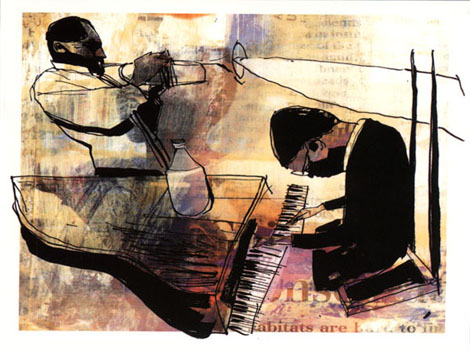
Miles Davis and Herbie Hancock by Dave McKean


Miles very much supported the idea of taking risks with the music. That's what he wanted us to do. He wanted us to constantly try to work on things, and constantly try to find new ways of expressing ourselves. So he very much encouraged risk-taking. As a matter of fact, he wasn't concerned at all about our mistakes. He was much more concerned about the courage that it takes to make mistakes. When you're on the edge, then you will make "mistakes"; if you're reaching for something, there will be "mistakes"--it's not going to sound so perfect. But it's the search and the honesty and the integrity that people can feel. They can hear it and they can feel it in their hearts. And that is what touches and moves them.

It is my Buddhist practice that is at the core of these realizations that I've had. It has really opened my eyes to things that I have observed and heard from my musical mentors. And I've been able to see how the things I have learned about creating music can be applied to life.

I've learned that any situation can be viewed from an infinite number of vantage points. With Miles I got that through music. I learned that a composition, a tune, a piece of music written by someone, is one example, one expression, of an idea. A jazz musician can take that song and, through the realization that it is an example, can create other examples by looking for other ways to view the piece of music.


That concept can also be applied to daily life. There is a natural tendency for us as human beings to see the situations that happen to us from one vantage point. But what Buddhism teaches us, and what life teaches us, is that a situation can be looked at in many, many different ways. And the way we look at that situation, and how we deal with it as a result of seeing it from other vantage points, can determine whether that life situation is going to have a negative or a positive effect on our future.
There are many things we get exposed to that at the outset appear to be negative, appear to be an obstacle or a problem. "Why did this happen to me?" That kind of reaction. But it is through those challenges that one can develop a strong foundation, deeper roots and an appreciation of one's own ability to overcome obstacles and to grow from them. This gives one a sense of self-worth. We can actually come to appreciate the obstacles themselves, and we can develop a deeper appreciation for our own life. So challenges are really an opportunity to get us closer to freedom. Real freedom is when you're not afraid of any situation that might happen to you in the future.

SGIQ: Can you talk about the relationship between creativity and suffering?

HH: There is a tendency for people to feel that an artist has to suffer, or pay his dues, in order to have a message that can translate as feeling through his art form. I don't deny the importance of having things to deal with in one's life, or how these can be instrumental in stimulating the creative juices. But what I realize at this point is that if you're striving hard to challenge yourself, whether it is through your art form, or whatever kind of job you may have, or with your family, or just the daily life that you live, there is no way you can avoid experiencing suffering to some degree. And it is through these sufferings and challenges that you can not only stimulate the creative juices but also develop a sense of self-sufficiency or autonomy. If you are not confronting such situations, it means either that you're not challenging your life or your art or that you're asleep, sleeping on the job, so to speak.

There is no one who can escape from suffering. Because materialism is so rampant and out of balance today, there's a tendency to think that if you're rich and you have the "right car," the "right job," a spouse or a mate, all those trappings, then you can be happy. When in fact it doesn't work that way. The most valuable qualities of life are priceless; they cannot be bought or sold. And they have more to do with recognizing that you can overcome situations in your life, recognizing that obstacles are the means for growth in your life, with developing compassion and appreciation for the people in your life, for the environment that we live in. Developing courage. There are so many important qualities that give life meaning and beauty and that dwarf that kind of materialistic viewpoint. Of course we all do need to be able to survive in life, but I think things have gone just too far in the materialistic direction.

SGIQ: Technology is often seen as a dehumanizing force in society. Do you think it also has creative possibilities to offer?

HH: As far as I can tell, there haven't been any real attempts to start a movement to explore the possible uses of technology to address the real issues of everyday life, the real problems. Like problems with peer pressure, man's inhumanity toward man, social problems, problems with sexism, problems with drugs, situations to do with sexual identity. All of the real things that people have to deal with in everyday life. I haven't seen anybody really attempt to explore the use of technology for those things. People in the world of technology have a tendency to be dazzled by it. And they think it is really helping the world--"Look how fast things are moving!" But look at the newspapers. Look at the front page, look at the first five pages. How many situations do you see in those first five pages where technology is being used? Generally, the answer is "none" because those possibilities haven't really been explored.

I've been noticing that quite often today you see the word "knowledge" or the word "information," especially in this new technological age. The word that seems to have disappeared from the vocabulary is the word "wisdom." You never see that anymore.

What most concerns me is that the human being is no longer the fulcrum, or the focus of life. It's somewhere low down on the list of priorities. If human happiness is not at the top of our concerns, then none of the other elements will have any meaning. What purpose is there for technology unless it somehow serves the human spirit and our relationship to the environment in which we live?
One of the initiatives that I've started is to explore the use of technology to address these human issues and concerns. I've started a foundation called the Rhythm of Life Foundation that will collect money for individuals and organizations that are doing this. I started to realize, once I embarked on that project, that I needed a means to develop some examples. So we formed the Rhythm of Life Organization (ROLO). Our first project is one we are conducting in the San Francisco Bay Area with the acronym BAYCAT, Bay View-Hunter's Point Center for the Arts and Technology. The idea for this school that we want to build is not only to be able to give young people access to high-end computers but also to teach them programming with the hope of encouraging them to develop software that deals with the issues that they face in everyday life. We want to encourage them to come up with new visions for the use of technology.

If you think about it, the people who built the technological age are now in the process of adapting to the age that they themselves built, whereas people who were born into it don't have to adapt. It comes naturally to them.

SGIQ: Why do you think it is important to work with young people?

HH: In the 1960s, a lot of major changes were instigated by people in their early teens. What they did really changed the world in many ways. I think that in the not-too-distant future, if we are lucky, a very similar kind of revolution can happen globally through the efforts of people in their teens. I am afraid that if something like this does not happen, not only is the future going to be rocky, but it will become more and more dangerous.

One of the things that I have realized is that so many of the problems that people have to face day-to-day are not problems created by the "have-nots." They've been primarily created by the "haves." Because, unlike the have-nots, the haves have been in the position to have that kind of global impact.

To be honest, I consider myself one of the haves. I'm one of the fortunate ones in life, on the planet. But there is a tendency for people who might be considered the haves to think that the have-nots have nothing to bring to the table of life. The haves, with all of their philanthropic intentions, are often coming from a position of arrogance, thinking that they are the only ones who have the capacity to bring anything to the table. There is a tendency for the haves to feel inherently superior to the have-nots, thinking that the have-nots are stupid, not bright enough. But what they don't realize is that it is not the have-nots who have created the problems for the world

What we need is to create a table of life where everyone is encouraged to bring whatever it is that they may have to offer. You can never tell where the next great concepts can come from. It may be from any place on the planet, including those places that are ignored, forgotten or even looked down upon. Unless we provide a means so that everyone may come to the table of life to bring what they have to offer, we can never experience the advantage of their impact in helping move life forward.
Very often the have-nots, in order to survive and overcome, have had to learn certain lessons in life. The haves may need that kind of creativity, wisdom and vision. Part of the undercurrent of ideas for the Rhythm of Life Organization comes from this kind of realization. The fact that on this planet we all need each other. And we need to help put each other in the position to provide the things we all need to move forward together.

 Source: SGI Quarterly (April 2001)

Feb 22, 2013

Embracing Age


"The ideal old age might be likened to a magnificent sunset. Just as the deep red of the setting sun holds the promise of a beautiful tomorrow, a life well lived conveys the gift of hope to future generations," writes Daisaku Ikeda, president of the SGI. 


Many more people are living longer, and in more and more countries the proportion of younger people in the population is decreasing. This causes fundamental changes in society, making it necessary for us to reassess the way we approach our lives--the journey through birth, aging and death, or "the life course," as some people have termed it. Mutual learning across the generations should mean all of us can live our lives in dignity.
 
What are the economic and social effects of the changing average age of the population? How can vulnerable groups access their fair share of society's resources? How can we develop medical resources and community services to respond to these changing demographics? Can we ensure that in our cities, towns and villages, the contribution of older people is valued, whilst also improving accessibility of public facilities?

Sadly, despite inspiring attempts to tackle these issues, elder abuse, age discrimination and stereotyping of older adults act as significant barriers to maximizing the potential of all. A movement toward an international Convention on the Rights of Older Persons is now under way, just as there is a Convention on the Rights of the Child. But whether or not the legal instruments are in place, we need to recognize that, in order for old age to be a time of fruition and fulfillment, we need to cherish and love life in all its different aspects and phases. Perhaps only then can we truly develop our inner strength, and--remembering that we too are becoming older--continue to shine brilliantly and advance with ever greater vitality.

 Source: SGI Quarterly

Sep 14, 2010

Compassion: Solidarity of the Heart

Tumblr

   The most basic wish of all people is to live happily. Yet human society is shaped by forces that work powerfully against this basic desire: from pervasive violence, to wanton environmental destruction, to the exploitation that structures such deep inequalities between people. Buddhism sheds light on the inner dynamics of human life that lead us to create such an undesirable reality. One of the most pernicious and powerful desires inherent in human life, according to Buddhist thought, is the desire for power over others, the urge to subjugate other people to our will. In this condition, the ego finds its most unrestrained and destructive expression, regarding others simply as a means to satisfy its selfish objectives.

Buddhism symbolically personifies this exploitative, authoritarian impulse as the Devil King of the Sixth Heaven, Its imprint is evident everywhere in our world. Recognizing the rampancy of this impulse, Nichiren, the 13th century founder of the Buddhism practiced by the SGI, described the world as the domain of the devil king, and all people as being under the rule of this devil. 

Tumblr

But if human nature is the cause of our most dire global problems, it is also the source of the fundamental solution. The countervailing force to the destructive aspect to human nature and the suffering it engenders is compassion, Compassion, a sense of solidarity with others-with all life- arising from a a wish for mutual happiness and growth, is the heart and origin of Buddhism.

In the original Sanskrit Buddhist texts, the concept of compassion is described by the words maitri and anukampa, Maitri indicates a sense of fellowship with others; anukampa describes a deep empathy that arises in the encounter with suffering and which gives rise to action, Buddhist compassion could be succinctly described then as the desire to relive suffering and to give joy.

Compassion is often thought of as akin to pity, but whereas pity may be condescending,m compassion springs from a sense of the equality and interconnectedness of life. Compassion is rooted in respect for the inherent dignity of life- our own and others'- and a desire to see that dignity triumph. As SGI president Ikeda writes, "True Buddhist compassion has nothing to do with sentimentality or mere pity. This is because sentimentality or mere pity cannot help the other person achieve victory in life; it cannot truly relieve suffering and impart joy."

Because genuine compassion is about empowering others, helping them unlock strength and courage from within their lives in order to overcome their problems, it may sometimes appear stern or contradictory. For example, although resolving a difficult situation for someone may seem compassionate, if this ends up making them weaker and less self-reliant, this will not contribute to their actual happiness in life. The effort to offer others effective encouragement for their specific circumstances is what gives rise to wisdom. Compassion and wisdom are thus closely related. Furthermore, even small acts of kindness require a degree of courage.  

Tumblr
 Nichiren establishes the practice of chanting Nam Myoho Renge Kyo as a practical means for people to bring forth the strength and rich potential of their humanity and live with confidence and joy. Sharing this practice with others is therefore the most essential act of compassion for practitioners of Nichiren Buddhism.

The transformation of society can only occur through a transformation of people's hearts. A life based on compassion means a staunch belief in the unrealized potential of others and ourselves. It is easy to give up on ourselves and others in the face of our failure and foolishness; such loss of faith in humanity is characteristic of our troubled world today. To continue to believe in and encourage the innate goodness and potential of or own and others' lives is the core of the philosophy of Nichiren Buddhism. It is also the bedrock of a firm optimism upon which all people can base their actions to bring about positive change in our world.

Source: SGI Quarterly July 2010


Jul 2, 2010

Human Dignity

How does Buddhism understand human dignity? 
From where does it spring? 
What supports and sustains it?

The starting point for Buddhism is the value and sanctity of life. For example, in one letter to a follower, Nichiren states that the value of a single day of life exceeds all other treasures. Buddhism further views each individual life as a manifestation of a universal life force.

From the Buddhist perspective, given the mind-boggling number of life-forms that fill the universe, human life is rare privilege with special responsibilities. As Nichiren, referring to a passage from the Nirvana Sutra, describes this: "It is rare to be born a human being. The number of those endowed with human life is as small as the amount of earth one can place on a fingernail."

What makes human life unique is the scale of our choice, the degree to which we are free to choose to act for good or evil, to help or to harm.
A recent book on the challenges of aging introduces the story of a young woman, married and with young children, who found herself suddenly in the position of having to care for her mother-in-law, bedridden following a stroke. At first the young woman could not understand why this had happened to her, why her already demanding life should be further burdened in this way. Through her Buddhist practice she was able to realize that she could, depending on how she chose to approach this situation, make of it an opportunity to create value. She was able to transform her initial feelings of resentment toward the older woman into a sense of appreciation.

Ultimately, the Buddhist understanding of human dignity is rooted in the idea that we are able to choose the path of self-perfection. We can, in other words, consistently make those difficult choices for creativity, growth and development. Buddhahood, or enlightenment, is how this state of self-perfection--a condition of fully developed courage, wisdom and compassion--is described. The idea that all people--all life, in fact--have this potential is expressed by the concept, stressed particularly in the Mahayana tradition, that all living beings possess Buddha nature.

In concrete, practical terms, this comes down to the idea that everyone has a mission--a unique role that only she or he can play, a unique perspective to offer, a unique contribution to make. As SGI President Daisaku Ikeda recently wrote in a book for high school students, "Everyone has a mission. The universe does nothing without purpose. The fact that we exist means that we have purpose."

The older woman in the story likewise sought to find a way to use her severely limited capacities to contribute to the well-being of the household. Since she still had use of her hands, she took up knitting--partly as a form of therapy, partly to make useful things for the family. She also enjoyed keeping watch over the home when the others were away.
From the Buddhist perspective, we always have the option of choosing to create value from even the most difficult situation. Through such choices we can fulfill our unique purpose and mission in life, and in this way give fullest expression to the inherent treasure of our human dignity. There is perhaps no more solid foundation for human rights than a general awakening to the human dignity that resides in every one of us.

(July 2000 SGI Quarterly)

Jan 20, 2010

A Strong Spirit (An Interview with Mariane Pearl)

Mariane Pearl's husband Danny was a Wall Street Journal reporter kidnapped and killed by extremists in Karachi, Pakistan, early in 2002 when she was pregnant with their first child. She describes her life and her struggles to promote peace and dialogue since that time. Mariane, also a journalist, is a member of the SGI. Her book A Mighty Heart: The Brave Life and Death of My Husband Danny Pearl is published by Scribner.


[Kiyotaka Shishido]SGI Quarterly: Can you share with us how you have dealt with your anger, sadness, and shock?

Mariane Pearl: It's an ongoing battle. It really is the knowledge that if I was going to be bitter, if I was going to be overwhelmed with anger, then there is some claim that those who killed Danny would have on me. And that is something I could not let them have. For me, living as a bitter person because of that, living as an angry person, is for me like living half-dead. So the challenge that I made the moment I learned of Danny's death was if I was going to live, I had to be alive, I had to trust, to love, to give and live as a whole person.

One incentive for doing that is Danny. I strongly believe that because he did the same thing, I was able to do it, too. He didn't give his captors anything. Whatever the physical aspect, the violence, you cannot get hold of a strong spirit. Danny, until the very end, was completely whole. He didn't give them anything. I had no doubt about it, and because I knew that I could not do less. He opposed them in the face of death, and I oppose them in the face of life. I knew that was going to be the most difficult thing to do, but I had to do that most difficult thing. So really it is not forgiveness. It is a defiance through my winning. I have no desire or incentive to forgive those people. I am his resolve, and our son Adam is his resolve. Symbolically, I was the first target after Danny. That's why I had to stand up.

The minute I found out about Danny's death, that moment, I had this deep understanding inside, and that is a benefit of my Buddhist practice. I knew exactly what my response should be. I knew without a shadow of a doubt that that is what Danny did. It was so clear. It was also the hardest moment of my life, because at that moment, to say "If I live, I want to be happy again," was almost unnatural, very daring. But I knew that was the answer.

I was all by myself in the same way that Danny was by himself--we were really close at that moment, we were living exactly the same thing. When he died, I knew we could not make our victory real if both of us were dead.

I was the only one who could stand up the next day and say, "That's what we're going to do." Not because I wanted to go on, but because I understood exactly what I had to do.

SGIQ: I am struck by the title of your book, A Mighty Heart. . . .

MP: Danny was a very warm, smart, very loving person. At the same time, he was a very ordinary person. I don't want Adam to think his father was a hero. He was able to stand up against those people when he understood he was going to die because the ground on which he walked was so solid. His ground was his ethics, his journalism, who he was as a person. At the moment of facing death, he didn't abandon any of that. When I knew about his death, I didn't refute any of it, either. That will be transmitted to Adam. I still believe in a world where people should work together, I still believe in altruism, in tolerance, in justice, all those elements that were the basis of our lives. All of those were so strong, so solid in us. I think that's why, at the moment of dying, he could say, I'm proud of who I am, as a journalist, as an American, a Jew, a man.

I know that at no point Danny begged, and I know that through, for instance, the photographs of him. In one there is a gun pointed at him and he has a smile on his face--how much stronger can you be than that? In another one he had shackles, but he's doing V for victory, and in the other he gives the finger. Every way possible he communicates his spirit. I think that's what I call a mighty heart, someone who holds onto their belief until the end.


[Kiyotaka Shishido]The people around us then became like that, too. There were Jewish people, there were Buddhist people, there were Muslims, there were Hindus, and there were Christians. Everybody at some point said, wow, we are the world--while the people who hold Danny have the opposite vision like the fascists had. It was like two visions of the world were confronting each other. My friend Captain, for example, he was a practicing Muslim--but we had the same goal. That was what mattered. We were all together to save an innocent man. It was like two opposite visions of the future that were fighting so hard. It is definitely a spiritual and mental battle, there is no question about that. Like if you retaliate physically--it would be so easy to kill any of those guys who hurt Danny--it wouldn't take me one minute.

But it is more difficult to do what I am doing. If I kill that guy, I'm not winning, I'm just keeping the vicious cycle going, because his son is going to hate me and maybe kill me, and my son, and it is going to go on like this. You can't fight them on their ground because it doesn't make any sense. It is a mental and spiritual battle.

That's how they recruit them, that's how in terrorist camps they are trained to lose their empathy--you can kill someone because you have convinced yourself that this guy is the enemy. You lose completely your empathy. That's what happens. So the only way to retaliate is to have more empathy and decide to save more people. That's the real battle. If you fight with weapons, they are always going to be more ruthless than you.

SGIQ: So how can we fight terrorism?

MP: Hope and compassion are the only real tools against terrorism. The more people have hope, the more people have empathy, the more people have determination. . . .

There is the law enforcement part and the political part, and I really hope that the UN will play its role. But ultimately we as ordinary people have to confront the terrorists and deny them their goals. I have seen the thousands of young men whose frustration makes them easy targets for recruiters. You know they go to mosques and recruit people, and they tell them that the Americans are the enemy, you should not hesitate to kill a Jew, and how it is holy to kill an American. It's all psychological. So you can only oppose with mental resistance. If it's revenge, they already won. If your mental resistance is based on revenge, that's it--they have claimed some human part of you. In that case we'd be like animals ourselves.

Being human is having this kind of spirit that you can't get hold of. Only because Danny was human was he able to show humanity to those people. It's only by cultivating our humanity that we can do that. There's all the reasons in the world to be fearful, to be depressed, but I have to tell people something they don't want to hear--it is about individual responsibility. Journalists are going to have to be more compassionate, you're going to have to reach out to Muslims, go where you are told not to go. They want to stop people traveling because that's how you build bridges between people. No, you have to go and travel. You should be careful, but if you stop reaching out to others, you are doing what the terrorists are seeking, they want a clash of civilizations. They want to stop dialogue. It's an act of resistance.

SGIQ: At first you said you thought SGI President Ikeda was naive and idealistic in promoting dialogue . . .

MP: Now I've had to have the courage to admit myself that it is the only powerful weapon we have. When you say that to people, they think it's such a lame thing--what can dialogue do against violence? But it's real and it's true. That's why I found sometimes my message is so difficult to get through. People want to fight, bomb and retaliate because it feels better. To go and fight, they think that's fine. You tell them no, when they want a clash; go instead, reach out--it works. How can I hate Pakistanis--one of my best friends, Captain, is a Muslim and a Pakistani. This man has been giving his life to try to save Danny, and then to bring justice to Adam and me. So it's a difficult message to convey because it does start with yourself, and sometimes I say to people, yes, you, in your kids' school, in your community--start a dialogue with the Muslims there--there's always something you can do.


[Kiyotaka Shishido]That's a difficult thing to admit. Not only are they attacking me, but I have to reach out to them. That's what being human is about--it's about resistance and a higher spirituality--there are two forces, one wants to bring you to your lowest common denominator which is this jungle thing, you hate me, I hate you, and the other wants to bring you to the more elevated answer.

It's such a fight for peace. It's a battle, it's nothing soft. It's a very demanding struggle because you're always going to come to a point where you're confronted with loneliness. It's about two possible futures for humanity fighting each other.

Once you understand that notion, maybe you start being able to empower yourself. Once you start that going, even if it's dialogue, power will come to you as you do it. It has to start from you first. But it's unbelievable the number of people who don't want to see me strong. They want to see a weeping widow, because it doesn't destroy their understanding of how things should be.

SGIQ: You want each person to stand up.

MP: It's a difficult message. You tell them that you can't make real changes if you don't start from yourself. The only thing I can do to provide hope is to say look, I did it, and I did it in the worst circumstances and that's the only way. I tell them, if I was counting on any government to get me out of this situation, what would I do, where would I be now? Where would I find any hope? If I was counting on politics, or economics even, any other set of values, I could not be here.

SGIQ: So what is needed?

MP: There is a need for more in-depth journalism, more lateral journalism. To help people understand the situation in depth. You're dealing with people who psychologically know us much better than we know them. This can't be left in the hands of law enforcement or politicians. Only human beings can bridge these divides--only real human contact can do that.

They want to destroy hope, therefore I shall preserve it by any possible means.
They want to kill trust. Thus I will reach out to others, Africans, Asians, Arabs, Americans and Jews alike.
They want to imprison people in labels and stereotypes. I will strive to maintain a dialogue, always focusing on the individuals rather than the symbol.
They want to kill joy in me, thus I will laugh again.
They want to paralyze me, therefore I will take action. They want to silence me--therefore I will speak out.

From a speech given by Mariane Pearl in Sydney, Australia in March 2004.