Showing posts with label Music. Show all posts

Feb 25, 2013

The Art of Life: Interview with Herbie Hancock


Herbie Hancock, a multiple Grammy award winner, is acknowledged as one of the great modern-jazz composers and a primary influence on contemporary jazz piano playing. In the mid--1960s, Hancock was at the creative center of the classic Miles Davis Quintet, a band whose musical innovations helped redefine the landscape of jazz. Even before this, in his early 20s, Hancock had recorded a number of albums, now considered classics of the genre.   


In the 1970s, Hancock's use of electronic keyboard instruments helped pioneer the development of jazz-rock and other fusion styles. Since then, as a creative innovator and explorer of new directions in music, he has continued to break new ground in jazz as well as recording a number of popular hits. His 1974 album, Headhunters, is one of the largest-selling jazz albums of all time. In 1986 he won an Oscar for his score for the film 'Round Midnight, in which he also had an acting role.

Hancock began practicing Buddhism and joined the SGI in 1972.

The SGI Quarterly interviewed Hancock about his experience of living a creative life.


SGI Quarterly: Can you talk about what it means to live a creative life? 

Herbie Hancock: At this point in my life, my primary focus is not on the art form that my career has been built around to date. What I focus on primarily is the real source--or the purpose--that my art form, music, is about. That is, life itself.
At the foundation of artistic expression is the very core of life. So what I'm finding is that the more I attempt to expand and develop my life, the greater the impact is on my music. Music becomes a tool for that expression. My focus is to practice this particular art form with the hope that ultimately it will be a catalyst in the listeners' appreciation of their own lives. My hope is not particularly that the audience will be inspired by my music and put me on a pedestal. That's not what it's about. I hope that somehow it triggers something within themselves where they feel that their life has more meaning, substance and inspiration. That they become more aware of something that is already in them.
That's the hope. And I think that where one is "coming from" is extremely important. Your vision for that pathway, your intention, is very important.

SGIQ: There seems to be a big distance between what you are saying and the general understanding of creative talent, or genius.

HH: There is a tendency for people to be very forgiving about the attitude of the artist, as long as the artistic expression pleases them. They almost expect an artist to be a little weird and a little egotistical, rude. But I'm very much against that. One very strong realization that I have at this point is that the most important art is one everyone is involved in, the art of living. And that is the most difficult one, the most important one to master and develop. And so everyone is an artist in that sense. This really helps me in my own appreciation of the lives of others.

SGIQ: What did you learn working with great masters like Miles Davis?

HH: I've been speaking pretty generally, but to be specific, there are certain characteristics that I strive to be aware of as being very important, and one of them is risk-taking. But, I have to add, with a sense of responsibility. Without a sense of responsibility you can get yourself in a lot of trouble taking risks.
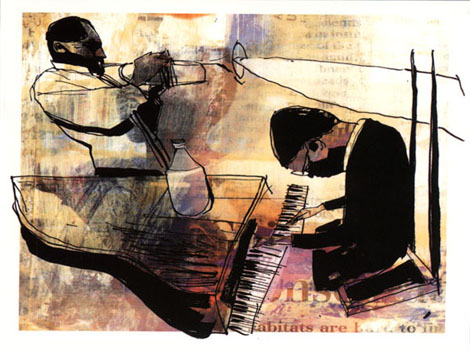
Miles Davis and Herbie Hancock by Dave McKean


Miles very much supported the idea of taking risks with the music. That's what he wanted us to do. He wanted us to constantly try to work on things, and constantly try to find new ways of expressing ourselves. So he very much encouraged risk-taking. As a matter of fact, he wasn't concerned at all about our mistakes. He was much more concerned about the courage that it takes to make mistakes. When you're on the edge, then you will make "mistakes"; if you're reaching for something, there will be "mistakes"--it's not going to sound so perfect. But it's the search and the honesty and the integrity that people can feel. They can hear it and they can feel it in their hearts. And that is what touches and moves them.

It is my Buddhist practice that is at the core of these realizations that I've had. It has really opened my eyes to things that I have observed and heard from my musical mentors. And I've been able to see how the things I have learned about creating music can be applied to life.

I've learned that any situation can be viewed from an infinite number of vantage points. With Miles I got that through music. I learned that a composition, a tune, a piece of music written by someone, is one example, one expression, of an idea. A jazz musician can take that song and, through the realization that it is an example, can create other examples by looking for other ways to view the piece of music.


That concept can also be applied to daily life. There is a natural tendency for us as human beings to see the situations that happen to us from one vantage point. But what Buddhism teaches us, and what life teaches us, is that a situation can be looked at in many, many different ways. And the way we look at that situation, and how we deal with it as a result of seeing it from other vantage points, can determine whether that life situation is going to have a negative or a positive effect on our future.
There are many things we get exposed to that at the outset appear to be negative, appear to be an obstacle or a problem. "Why did this happen to me?" That kind of reaction. But it is through those challenges that one can develop a strong foundation, deeper roots and an appreciation of one's own ability to overcome obstacles and to grow from them. This gives one a sense of self-worth. We can actually come to appreciate the obstacles themselves, and we can develop a deeper appreciation for our own life. So challenges are really an opportunity to get us closer to freedom. Real freedom is when you're not afraid of any situation that might happen to you in the future.

SGIQ: Can you talk about the relationship between creativity and suffering?

HH: There is a tendency for people to feel that an artist has to suffer, or pay his dues, in order to have a message that can translate as feeling through his art form. I don't deny the importance of having things to deal with in one's life, or how these can be instrumental in stimulating the creative juices. But what I realize at this point is that if you're striving hard to challenge yourself, whether it is through your art form, or whatever kind of job you may have, or with your family, or just the daily life that you live, there is no way you can avoid experiencing suffering to some degree. And it is through these sufferings and challenges that you can not only stimulate the creative juices but also develop a sense of self-sufficiency or autonomy. If you are not confronting such situations, it means either that you're not challenging your life or your art or that you're asleep, sleeping on the job, so to speak.

There is no one who can escape from suffering. Because materialism is so rampant and out of balance today, there's a tendency to think that if you're rich and you have the "right car," the "right job," a spouse or a mate, all those trappings, then you can be happy. When in fact it doesn't work that way. The most valuable qualities of life are priceless; they cannot be bought or sold. And they have more to do with recognizing that you can overcome situations in your life, recognizing that obstacles are the means for growth in your life, with developing compassion and appreciation for the people in your life, for the environment that we live in. Developing courage. There are so many important qualities that give life meaning and beauty and that dwarf that kind of materialistic viewpoint. Of course we all do need to be able to survive in life, but I think things have gone just too far in the materialistic direction.

SGIQ: Technology is often seen as a dehumanizing force in society. Do you think it also has creative possibilities to offer?

HH: As far as I can tell, there haven't been any real attempts to start a movement to explore the possible uses of technology to address the real issues of everyday life, the real problems. Like problems with peer pressure, man's inhumanity toward man, social problems, problems with sexism, problems with drugs, situations to do with sexual identity. All of the real things that people have to deal with in everyday life. I haven't seen anybody really attempt to explore the use of technology for those things. People in the world of technology have a tendency to be dazzled by it. And they think it is really helping the world--"Look how fast things are moving!" But look at the newspapers. Look at the front page, look at the first five pages. How many situations do you see in those first five pages where technology is being used? Generally, the answer is "none" because those possibilities haven't really been explored.

I've been noticing that quite often today you see the word "knowledge" or the word "information," especially in this new technological age. The word that seems to have disappeared from the vocabulary is the word "wisdom." You never see that anymore.

What most concerns me is that the human being is no longer the fulcrum, or the focus of life. It's somewhere low down on the list of priorities. If human happiness is not at the top of our concerns, then none of the other elements will have any meaning. What purpose is there for technology unless it somehow serves the human spirit and our relationship to the environment in which we live?
One of the initiatives that I've started is to explore the use of technology to address these human issues and concerns. I've started a foundation called the Rhythm of Life Foundation that will collect money for individuals and organizations that are doing this. I started to realize, once I embarked on that project, that I needed a means to develop some examples. So we formed the Rhythm of Life Organization (ROLO). Our first project is one we are conducting in the San Francisco Bay Area with the acronym BAYCAT, Bay View-Hunter's Point Center for the Arts and Technology. The idea for this school that we want to build is not only to be able to give young people access to high-end computers but also to teach them programming with the hope of encouraging them to develop software that deals with the issues that they face in everyday life. We want to encourage them to come up with new visions for the use of technology.

If you think about it, the people who built the technological age are now in the process of adapting to the age that they themselves built, whereas people who were born into it don't have to adapt. It comes naturally to them.

SGIQ: Why do you think it is important to work with young people?

HH: In the 1960s, a lot of major changes were instigated by people in their early teens. What they did really changed the world in many ways. I think that in the not-too-distant future, if we are lucky, a very similar kind of revolution can happen globally through the efforts of people in their teens. I am afraid that if something like this does not happen, not only is the future going to be rocky, but it will become more and more dangerous.

One of the things that I have realized is that so many of the problems that people have to face day-to-day are not problems created by the "have-nots." They've been primarily created by the "haves." Because, unlike the have-nots, the haves have been in the position to have that kind of global impact.

To be honest, I consider myself one of the haves. I'm one of the fortunate ones in life, on the planet. But there is a tendency for people who might be considered the haves to think that the have-nots have nothing to bring to the table of life. The haves, with all of their philanthropic intentions, are often coming from a position of arrogance, thinking that they are the only ones who have the capacity to bring anything to the table. There is a tendency for the haves to feel inherently superior to the have-nots, thinking that the have-nots are stupid, not bright enough. But what they don't realize is that it is not the have-nots who have created the problems for the world

What we need is to create a table of life where everyone is encouraged to bring whatever it is that they may have to offer. You can never tell where the next great concepts can come from. It may be from any place on the planet, including those places that are ignored, forgotten or even looked down upon. Unless we provide a means so that everyone may come to the table of life to bring what they have to offer, we can never experience the advantage of their impact in helping move life forward.
Very often the have-nots, in order to survive and overcome, have had to learn certain lessons in life. The haves may need that kind of creativity, wisdom and vision. Part of the undercurrent of ideas for the Rhythm of Life Organization comes from this kind of realization. The fact that on this planet we all need each other. And we need to help put each other in the position to provide the things we all need to move forward together.

 Source: SGI Quarterly (April 2001)

Sep 13, 2011

Refuse to be Held Down


Ain't No Stoppin Us Now!
We're on the move!
Ain't No Stoppin Us Now!
We've got the groove!

There's been so many things thats held us down.
But now it looks like things are finally comin' around.
I know we've got, a long long way to go,
and where we'll end up, I don't know.
But we won't let nothin' hold us back,
we're putting our selves together,
we're polishing up our act!
If you felt we've been held down before,
I know you'll refuse to be held down anymore!

Don't you let nothing, nothing,
Stand in your way!
I want ya'll to listen, listen,
to every word I say, every word I say!

Ain't No Stoppin Us Now!
We're on the move!
Ain't No Stoppin Us Now!
We've got the groove!

Ain't No Stoppin Us Now!
We're on the move!
Ain't No Stoppin Us Now!
We've got the groove!

I know you know someone that has a negative vow,
and if you're trying to make it they only push you aside.
They really don't have, no where to go.
Ask them where they're going, they don't know.
But we won't let nothin' hold us back,
we're gonna put our selves together,
we're gonna polish up our act!
And if you've ever been held down before,
I know you'll refuse to be held down anymore!

Don't you let nothing, nothing,
Stand in your way!
I want ya'll to listen, listen,
to every word I say, every word I say!

Ain't No Stoppin Us Now!
We're on the move!
Ain't No Stoppin Us Now!
We've got the groove!

Ain't No Stoppin Us Now!
We're on the move!
Ain't No Stoppin Us Now!
We've got the groove!


by MacFadden and Whitehead

Feb 28, 2011

My 4th Year

Today, I celebrate my Gohonzon Birthday. Its been 4 years now since I became a Nichiren Buddhist and I know now when they say that it is easy to start but harder to continue. I've said this before and I will say it again. But I also wanted to add that a Buddhist practice is a lifelong journey. Its never-ending. I've met many members who've been practicing longer than I have, some over 30 years. And most of them have shared with me how they are still learning and discovering what they are made of through the power of Nam Myoho Renge Kyo.
My Gohonzon was presented to me by the wonderful late Tim Dennis at the White Plains cultural center. I remember that day like it was yesterday. I was so ready. I felt it in my bones. I felt like I was shot into the sun. I was beaming. I anxiously awaited the day to enshrine my Gohonzon. I was excited and went out and bought everything for my Butsudan. I could feel myself glowing.
Fast forward 4 years now and that glow is still there despite struggles. It glows dimly, at times flickers, other times I have to re-light it. But one thing's for sure, that inner light will never stay dark as long as I have my Buddhist practice.

Thank you for all the lovely and encouraging words. Let's continue this journey together.

Sincerely, Seleus/Lotus Flower


WHAT A FEELING (I can have it all, now I'm Chanting for my Life)

First, when there's nothing but a slow glowing dream
That your fear seems to hide deep inside your mind
All alone I have cried silent tears full of pride
In a world made of steel, made of stone

Well I hear the music, close my eyes, feel the rhythm
Wrap around, take a hold of my heart
What a feeling, bein's believin'
I can have it all, now I'm chanting for my life

What a feeling
Take your passion, and make it happen
Dreams come alive, you can chant right through your life

Now I hear the music, close my eyes, I am rhythm
In a flash it takes hold of my heart


What a feeling, bein's believin'
I can have it all, now I'm chanting for my life
What a feeling
What a feeling (I am chanting now), bein's believin' (I am rhythm now)
Dreams come alive, you can dance right through your life
What a feeling (I can really have it all)
What a feeling (Dreams come alive when I chant)
I can have it all (I can really have it all)
Have it all (Dreams come alive when I chant)
(chant, chant, chant, chant, what a feeling) I can have it all

(Revised words by Maria Centeno)

Dec 30, 2010

You Should be Dancing

Singapore Soka Association celebrating Soka Gakkai's 80th Anniversary Commemorative Meeting on the 25th of December 2010.

Soka Youth Dance Crew (SYDC)
Performance at the Singapore Indoor Stadium.

Choreography by:
We're Dancing by P.Y.T - Lester Zhang
Party To Damascus by Wyclef Jean feat. Missy Elliot - Jeremy Tan
Red Alert by Basement Jaxx - Kher Xin + Freddie Ng
You Should Be Dancing by Bee Gees - Kher Xin + Freddie Ng
Song of Indomitable Spirit Instrumental Edit - Marcus Leong

Sep 19, 2010

Groovy Daimoku

The Music Emporium: "Nam Myo Ho Renge Kyo / Times Like This" Sentinel Records 4-501 Promo 1969
Initially called "The Cage", "THE MUSIC EMPORIUM" was a Los Angeles creative quartet, comprised of "Dora Wahl" (drums), "Carolyn Lee", (bass guitar and also played piano and sometimes, organ), "Dave Padwin" (guitar), and "Bill 'Casey' Cosby" ("Farfisa Compact Organ").


Sep 7, 2010

Joseph Bowie

Joseph Bowie was born on October 17, 1953 in St Louis, Missouri.  He is a  American bandleader, trombonist, and founder of the seminal jazz fusion band, Defunkt. The group has been blending jazz with funk and punk music for more than three consecutive decades.

Bowie is the younger brother of world renowned avant-garde jazz trumpeter Lester Bowie, and saxophonist Byron Bowie. 

After recovering from a bout with drug addiction during the 1980s, Bowie discovered Buddhism and has been a practicing Buddhist ever since. He has since founded Kosen-Rufu, another musical outfit aside from Defunkt. In 2003 Bowie moved to The Netherlands, where he lives in the small town of Gorinchem where he works with a number of groups.

In this short documentary, James talks about how he was introduced to the practice, why and chants. Fast forward the video to the time 5:38 to see this. 

Aug 25, 2010

Wayne Shorter

Happy Birthday Wayne Shorter
Fellow Nichiren Buddhist


4th track from Wayne Shorter's "Adam's Apple" album, FEBRUARY 24, 1966.
Blue Note Records. The track it's one of the greatest Wayne Shorter's compositions and appears on Miles Davis Quintet's "Miles Smiles" Album.

"One thing I could never do is play something over and over again. If I have it, I know it's there to be played over and over, but to actually confirm this "something" the value of playing it over and over and over again is like a web that's spun but you can't get out of it. When you become neutral the music is more alive than you. That goes for anything, even eating too much ice cream. The ice cream is very much alive, but you're dead. The same with liquor, cocaine, and drugs, dwelling on something so that you have to end up in an institution. Three attachments usually need to suffer." - Wayne Shorter 

The Saxophone Journal 1992
 

Aug 10, 2010

Keep Movin' On


Keep movin' on, keep movin' on
life is this way
Keep movin' on, keep movin' on
everyday

When I go to sleep at night
I add up my day
trying to recall the things I done
and debts I have to pay
for there is one thing that I know
what you reap is what you sow

Keep movin' on, keep movin' on
life is this way
Keep movin' on, keep movin' on
everyday

Brother mind what you do
and how your treat your fellow man
if you're like me you'd try to live
the very best you can
for if you spread good all around
you'd be able to sleep when the sun goes down

Keep movin' on, keep movin' on
life is this way
Keep movin' on, keep movin' on
everyday

Aug 2, 2010

Learn to fly


Songwriters: John Lennon and Paul Mccartney
Blackbird singing in the dead of night
Take these broken wings and learn to fly
All your life
You were only waiting for this moment to arise

Blackbird singing in the dead of night
Take these sunken eyes and learn to see
All your life
You were only waiting for this moment to be free

Blackbird fly, blackbird fly
Into the light of the dark black night

Blackbird fly, blackbird fly
Into the light of the dark black night

Blackbird singing in the dead of night
Take these broken wings and learn to fly
All your life
You were only waiting for this moment to arise

                                          tumblr

Jul 16, 2010

Josho State of Mind- (Empire State of Mind remix by SGI-New York)

SGI-New York - "Josho State of Mind" (Empire State of Mind remix) 

Josho is a Japanese term meaning "Ever Victorious"


Jul 10, 2010

East Territory's Rock the Era

Somewhere Over The Rainbow


Rock the Era - Hip Hop

Rock the Era 2010

In commemoration of 80 years since the founding of the SGI (Soka Gakkai International) and 50 years since SGI President Ikeda first arrived to America, the youth of America will be hosting a monumental celebration filled with performances and everlasting memories. These videos series document the efforts of SGI members and various supporting groups working towards this celebration that will take place in 2010. Everyone is welcome to participate in this event. Practices are held twice a month at various locations. Please contact SGI-USA. Visit www.sgi-usa.org for phone numbers and locations. 


Jul 8, 2010

Actual Proof by Herbie Hancock


Herbie Hancock and Nichiren Buddhism
His Story 


Well, back in 1972, my band was playing music that required a very intuitive sense. It was an avant-garde approach to playing jazz. So it was very much in the moment and spontaneous. We had structure, but it was a very loose structure. So we went though a period when we were vegetarians because we would keep trying to find things that would help the flow of the music. I was very open at that time. 
One night on a certain tour in mid-1972 we played a club in Seattle, Washington. It was a Friday night and the club was packed. We were all exhausted because we had only gotten a couple hours of sleep because we had been hanging out all night before. But we could feel the energy in the air—these people were really into this far out kind of music. They were ready for it. I asked the band to play "Toys," a song that I’d never called to play, which starts with a bass solo—acoustic bass, which is the softest instrument in the band by its very nature. Un-amplified bass. 

So the bassist Buster Williams starts playing this introduction. And what came out of him was something I’d never heard before. And not only had I not heard it from him, I’d never heard it from anybody. It was just pure beauty and ideas and—it was magical. Magical. And people were freaking out, it was so incredible what he was playing.


I let him play for a long time, maybe 10, 15 minutes. He just came up with idea after idea, so full of inspiration. And then I could feel myself waking up just before we really came in with the melody for the song. And I could tell that the whole band woke up, and there was some energy that was generating from Buster. We played the set and it was like magic. When we finished, many people ran up to the front of the stage and reached up their hands to shake ours. Some of them were crying they were so moved by the music. The music was very spiritual, too.


I knew that Buster was the catalyst for all of this, so I took him into the musicians’ room, and I said, “Hey, Buster, I heard you were into some new philosophy or something and if it can make you play bass like that, I want to know what it is.”

And then all his eyes lit up and he said, “I’ve been chanting for a way to tell you about this.” And I said, “What? Chanting what? What is this?” And now I know that it was the only way he could have reached me. That would be the only way I would have listened to what he had to say. If he had just come up and told me about it beforehand, I would have probably put my hand on his shoulder and said, “Hey, man, that’s great. You know, whatever works for you keep doing it,” which is a way of putting up a shield. But it came through the music, which was the only way to kind of reach my heart at the time, because that’s what my focus was then.

So, that was when he first told me about Buddhism and about chanting Nam-myoho-renge-kyo , which is the primary thing we do. It's the sound of the essence of everything. So, that was the beginning.

Then what happened?
I asked him some questions. I’d ask him one question, but his answers answered five or six questions that I already had in my head. Even though I had read some books on Sufism and Eastern thought, many of those things that I had read just brought up more questions than they did answers. This was the first time I was hearing something that was giving me simple answers to questions that answered more than one thing that I had in my mind. It all seemed to kind of tie together and work in such a beautiful way.

I mean, having been brought up in the Christian tradition, I had my own spin on Christianity. And most people that I knew that were Christians had their own spin on it. But what he was telling me sounded like my own personal take on religion and the way to look at things. And I said, "This sounds like what I always believed in anyway. I thought I was the only one." He said, “No, there are, you know, close to 20 million people that believe the same thing.”

I was kind of startled when he talked about Nam-myoho-renge-kyo being the law of the universe. The idea of cause and effect, which is what Nam-myoho-renge-kyo is about, made sense to me. I’m a guy that’s always been attracted to science—and cause and effect is what science is about. But I said, "I can’t just believe that chanting the sound is going to do something, so I don’t see how it could work for me."
He said, “Oh, you don’t have to believe it. It’s a law. So, if you just do it, it’ll--you’ll see the effect in your life. It doesn’t depend on you having to believe it first.” 

READ MORE

Jun 29, 2010

Seize the Day

Song written and performed by Maria Centeno
(From my District- Fordham Hill Group Leader)

This was performed at my last Chapter meeting accompanied by a Malik Brown on violin and Ray Rivera on percussion 

                          (Source: Tumblr)


Seize the Day 

Seize the Day, A New Beginning
To Light Our Way
Seize the Day, We see our Victory
Bright as a Flame
--- We Seize the Day

There are mountains we must climb,
Rivers we will cross, (and)
With the rising of the sun,
We look beyond the sky,
Say this day is mine; this day is yours---

Seize the Day
Brave hearts are beating
Aflame with Flame
Seize the Day,
We march on fearlessly
Along with Sensei/ (Our Friends)
--- We Seize the Day

With a youthful spirit we rise
Inner strength moves our lives
Courageous will is high!
We look beyond the sky
Say, this day is mine; This Day is yours.


Jun 22, 2010

The Rest is still Unwritten

I am unwritten, can't read my mind, I'm undefined
I'm just beginning, the pen's in my hand, ending unplanned


Staring at the blank page before you
Open up the dirty window
Let the sun illuminate the words that you could not find

Reaching for something in the distance
So close you can almost taste it
Release your inhibitions
Feel the rain on your skin
No one else can feel it for you
Only you can let it in
No one else, no one else
Can speak the words on your lips
Drench yourself in words unspoken
Live your life with arms wide open
Today is where your book begins
The rest is still unwritten

Oh, oh, oh

I break tradition, sometimes my tries, are outside the lines
We've been conditioned to not make mistakes, but I can't live that way

Staring at the blank page before you
Open up the dirty window
Let the sun illuminate the words that you could not find

Reaching for something in the distance
So close you can almost taste it
Release your inhibitions
Feel the rain on your skin
No one else can feel it for you
Only you can let it in
No one else, no one else
Can speak the words on your lips
Drench yourself in words unspoken
Live your life with arms wide open
Today is where your book begins

Feel the rain on your skin
No one else can feel it for you
Only you can let it in
No one else, no one else
Can speak the words on your lips
Drench yourself in words unspoken
Live your life with arms wide open
Today is where your book begins
The rest is still unwritten

Jun 16, 2010

Defy Gravity

I'm through accepting limits cause someone says they're so.....
Everyone deserves the chance to fly! 
And if I'm flying solo at least I'm flying free, tell them how I am Defying Gravity

Our lives are our own. It is not for someone else to dictate to us how we should live. All that awaits those who allow themselves to be continually swayed by what other people say or do is unhappiness. We simply need to have the self-belief to be able to say: "This is right. This is the path I will follow. I am content." Happiness is born from such inner fortitude. Moreover, those who earnestly devote themselves in accord with the Mystic Law cannot daily to realize lives of total fulfillment.  

Faith Into Action~Ikeda


The wonderful Idina Menzel and Kristen Chenowith from the cast of "Wicked"

May 5, 2010

My Uncle Anthony

My Uncle Anthony has the right idea here.....

Mar 26, 2010

Freckles

Freckles
by Natasha Bedingfield

I used to care so much about what others think about
Almost didn’t have a thought of my own
The slightest remark would make me embark
On the journey of self doubt
But that was a while ago
This girl has got stronger
If I knew then what I know now
I would have told myself don’t worry any longer it's OK


'cause a face without freckles is like a sky without stars
Why waste a second not loving who you are
Those little imperfections make you beautiful, lovable, valuable,
They show your personality inside your heart
Reflecting who you are


Who you are
Who you are
Who you are

I wondered if I could trade my body with somebody else in magazines
With the whole world full at my feet
I phantom worthy and would blame my failures on the ugliness I could see
When the mirror looked at me
Sometimes I feel like the little girl who doesn’t belong in her own world
But I'm getting better
And I'm reminding myself


[Chorus]

Reflecting who you are


Source: Photos by me, deviantart)