Feb 25, 2013

The Art of Life: Interview with Herbie Hancock


Herbie Hancock, a multiple Grammy award winner, is acknowledged as one of the great modern-jazz composers and a primary influence on contemporary jazz piano playing. In the mid--1960s, Hancock was at the creative center of the classic Miles Davis Quintet, a band whose musical innovations helped redefine the landscape of jazz. Even before this, in his early 20s, Hancock had recorded a number of albums, now considered classics of the genre.   


In the 1970s, Hancock's use of electronic keyboard instruments helped pioneer the development of jazz-rock and other fusion styles. Since then, as a creative innovator and explorer of new directions in music, he has continued to break new ground in jazz as well as recording a number of popular hits. His 1974 album, Headhunters, is one of the largest-selling jazz albums of all time. In 1986 he won an Oscar for his score for the film 'Round Midnight, in which he also had an acting role.

Hancock began practicing Buddhism and joined the SGI in 1972.

The SGI Quarterly interviewed Hancock about his experience of living a creative life.


SGI Quarterly: Can you talk about what it means to live a creative life? 

Herbie Hancock: At this point in my life, my primary focus is not on the art form that my career has been built around to date. What I focus on primarily is the real source--or the purpose--that my art form, music, is about. That is, life itself.
At the foundation of artistic expression is the very core of life. So what I'm finding is that the more I attempt to expand and develop my life, the greater the impact is on my music. Music becomes a tool for that expression. My focus is to practice this particular art form with the hope that ultimately it will be a catalyst in the listeners' appreciation of their own lives. My hope is not particularly that the audience will be inspired by my music and put me on a pedestal. That's not what it's about. I hope that somehow it triggers something within themselves where they feel that their life has more meaning, substance and inspiration. That they become more aware of something that is already in them.
That's the hope. And I think that where one is "coming from" is extremely important. Your vision for that pathway, your intention, is very important.

SGIQ: There seems to be a big distance between what you are saying and the general understanding of creative talent, or genius.

HH: There is a tendency for people to be very forgiving about the attitude of the artist, as long as the artistic expression pleases them. They almost expect an artist to be a little weird and a little egotistical, rude. But I'm very much against that. One very strong realization that I have at this point is that the most important art is one everyone is involved in, the art of living. And that is the most difficult one, the most important one to master and develop. And so everyone is an artist in that sense. This really helps me in my own appreciation of the lives of others.

SGIQ: What did you learn working with great masters like Miles Davis?

HH: I've been speaking pretty generally, but to be specific, there are certain characteristics that I strive to be aware of as being very important, and one of them is risk-taking. But, I have to add, with a sense of responsibility. Without a sense of responsibility you can get yourself in a lot of trouble taking risks.
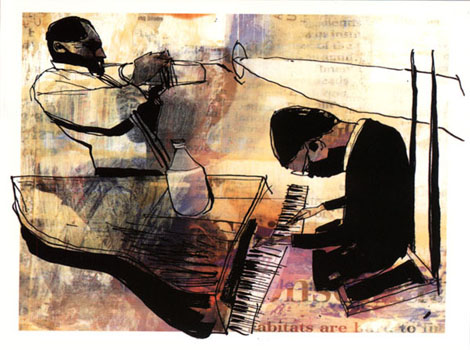
Miles Davis and Herbie Hancock by Dave McKean


Miles very much supported the idea of taking risks with the music. That's what he wanted us to do. He wanted us to constantly try to work on things, and constantly try to find new ways of expressing ourselves. So he very much encouraged risk-taking. As a matter of fact, he wasn't concerned at all about our mistakes. He was much more concerned about the courage that it takes to make mistakes. When you're on the edge, then you will make "mistakes"; if you're reaching for something, there will be "mistakes"--it's not going to sound so perfect. But it's the search and the honesty and the integrity that people can feel. They can hear it and they can feel it in their hearts. And that is what touches and moves them.

It is my Buddhist practice that is at the core of these realizations that I've had. It has really opened my eyes to things that I have observed and heard from my musical mentors. And I've been able to see how the things I have learned about creating music can be applied to life.

I've learned that any situation can be viewed from an infinite number of vantage points. With Miles I got that through music. I learned that a composition, a tune, a piece of music written by someone, is one example, one expression, of an idea. A jazz musician can take that song and, through the realization that it is an example, can create other examples by looking for other ways to view the piece of music.


That concept can also be applied to daily life. There is a natural tendency for us as human beings to see the situations that happen to us from one vantage point. But what Buddhism teaches us, and what life teaches us, is that a situation can be looked at in many, many different ways. And the way we look at that situation, and how we deal with it as a result of seeing it from other vantage points, can determine whether that life situation is going to have a negative or a positive effect on our future.
There are many things we get exposed to that at the outset appear to be negative, appear to be an obstacle or a problem. "Why did this happen to me?" That kind of reaction. But it is through those challenges that one can develop a strong foundation, deeper roots and an appreciation of one's own ability to overcome obstacles and to grow from them. This gives one a sense of self-worth. We can actually come to appreciate the obstacles themselves, and we can develop a deeper appreciation for our own life. So challenges are really an opportunity to get us closer to freedom. Real freedom is when you're not afraid of any situation that might happen to you in the future.

SGIQ: Can you talk about the relationship between creativity and suffering?

HH: There is a tendency for people to feel that an artist has to suffer, or pay his dues, in order to have a message that can translate as feeling through his art form. I don't deny the importance of having things to deal with in one's life, or how these can be instrumental in stimulating the creative juices. But what I realize at this point is that if you're striving hard to challenge yourself, whether it is through your art form, or whatever kind of job you may have, or with your family, or just the daily life that you live, there is no way you can avoid experiencing suffering to some degree. And it is through these sufferings and challenges that you can not only stimulate the creative juices but also develop a sense of self-sufficiency or autonomy. If you are not confronting such situations, it means either that you're not challenging your life or your art or that you're asleep, sleeping on the job, so to speak.

There is no one who can escape from suffering. Because materialism is so rampant and out of balance today, there's a tendency to think that if you're rich and you have the "right car," the "right job," a spouse or a mate, all those trappings, then you can be happy. When in fact it doesn't work that way. The most valuable qualities of life are priceless; they cannot be bought or sold. And they have more to do with recognizing that you can overcome situations in your life, recognizing that obstacles are the means for growth in your life, with developing compassion and appreciation for the people in your life, for the environment that we live in. Developing courage. There are so many important qualities that give life meaning and beauty and that dwarf that kind of materialistic viewpoint. Of course we all do need to be able to survive in life, but I think things have gone just too far in the materialistic direction.

SGIQ: Technology is often seen as a dehumanizing force in society. Do you think it also has creative possibilities to offer?

HH: As far as I can tell, there haven't been any real attempts to start a movement to explore the possible uses of technology to address the real issues of everyday life, the real problems. Like problems with peer pressure, man's inhumanity toward man, social problems, problems with sexism, problems with drugs, situations to do with sexual identity. All of the real things that people have to deal with in everyday life. I haven't seen anybody really attempt to explore the use of technology for those things. People in the world of technology have a tendency to be dazzled by it. And they think it is really helping the world--"Look how fast things are moving!" But look at the newspapers. Look at the front page, look at the first five pages. How many situations do you see in those first five pages where technology is being used? Generally, the answer is "none" because those possibilities haven't really been explored.

I've been noticing that quite often today you see the word "knowledge" or the word "information," especially in this new technological age. The word that seems to have disappeared from the vocabulary is the word "wisdom." You never see that anymore.

What most concerns me is that the human being is no longer the fulcrum, or the focus of life. It's somewhere low down on the list of priorities. If human happiness is not at the top of our concerns, then none of the other elements will have any meaning. What purpose is there for technology unless it somehow serves the human spirit and our relationship to the environment in which we live?
One of the initiatives that I've started is to explore the use of technology to address these human issues and concerns. I've started a foundation called the Rhythm of Life Foundation that will collect money for individuals and organizations that are doing this. I started to realize, once I embarked on that project, that I needed a means to develop some examples. So we formed the Rhythm of Life Organization (ROLO). Our first project is one we are conducting in the San Francisco Bay Area with the acronym BAYCAT, Bay View-Hunter's Point Center for the Arts and Technology. The idea for this school that we want to build is not only to be able to give young people access to high-end computers but also to teach them programming with the hope of encouraging them to develop software that deals with the issues that they face in everyday life. We want to encourage them to come up with new visions for the use of technology.

If you think about it, the people who built the technological age are now in the process of adapting to the age that they themselves built, whereas people who were born into it don't have to adapt. It comes naturally to them.

SGIQ: Why do you think it is important to work with young people?

HH: In the 1960s, a lot of major changes were instigated by people in their early teens. What they did really changed the world in many ways. I think that in the not-too-distant future, if we are lucky, a very similar kind of revolution can happen globally through the efforts of people in their teens. I am afraid that if something like this does not happen, not only is the future going to be rocky, but it will become more and more dangerous.

One of the things that I have realized is that so many of the problems that people have to face day-to-day are not problems created by the "have-nots." They've been primarily created by the "haves." Because, unlike the have-nots, the haves have been in the position to have that kind of global impact.

To be honest, I consider myself one of the haves. I'm one of the fortunate ones in life, on the planet. But there is a tendency for people who might be considered the haves to think that the have-nots have nothing to bring to the table of life. The haves, with all of their philanthropic intentions, are often coming from a position of arrogance, thinking that they are the only ones who have the capacity to bring anything to the table. There is a tendency for the haves to feel inherently superior to the have-nots, thinking that the have-nots are stupid, not bright enough. But what they don't realize is that it is not the have-nots who have created the problems for the world

What we need is to create a table of life where everyone is encouraged to bring whatever it is that they may have to offer. You can never tell where the next great concepts can come from. It may be from any place on the planet, including those places that are ignored, forgotten or even looked down upon. Unless we provide a means so that everyone may come to the table of life to bring what they have to offer, we can never experience the advantage of their impact in helping move life forward.
Very often the have-nots, in order to survive and overcome, have had to learn certain lessons in life. The haves may need that kind of creativity, wisdom and vision. Part of the undercurrent of ideas for the Rhythm of Life Organization comes from this kind of realization. The fact that on this planet we all need each other. And we need to help put each other in the position to provide the things we all need to move forward together.

 Source: SGI Quarterly (April 2001)

Feb 22, 2013

Embracing Age


"The ideal old age might be likened to a magnificent sunset. Just as the deep red of the setting sun holds the promise of a beautiful tomorrow, a life well lived conveys the gift of hope to future generations," writes Daisaku Ikeda, president of the SGI. 


Many more people are living longer, and in more and more countries the proportion of younger people in the population is decreasing. This causes fundamental changes in society, making it necessary for us to reassess the way we approach our lives--the journey through birth, aging and death, or "the life course," as some people have termed it. Mutual learning across the generations should mean all of us can live our lives in dignity.
 
What are the economic and social effects of the changing average age of the population? How can vulnerable groups access their fair share of society's resources? How can we develop medical resources and community services to respond to these changing demographics? Can we ensure that in our cities, towns and villages, the contribution of older people is valued, whilst also improving accessibility of public facilities?

Sadly, despite inspiring attempts to tackle these issues, elder abuse, age discrimination and stereotyping of older adults act as significant barriers to maximizing the potential of all. A movement toward an international Convention on the Rights of Older Persons is now under way, just as there is a Convention on the Rights of the Child. But whether or not the legal instruments are in place, we need to recognize that, in order for old age to be a time of fruition and fulfillment, we need to cherish and love life in all its different aspects and phases. Perhaps only then can we truly develop our inner strength, and--remembering that we too are becoming older--continue to shine brilliantly and advance with ever greater vitality.

 Source: SGI Quarterly

Feb 19, 2013

How to Chant

A short film demonstrating how to begin chanting Nam-myoho-renge-kyo, explaining its meaning and introducing the daily Buddhist practice of SGI members around the world.


Source: SGI

Dec 16, 2012

Good and Evil

"If we lack the courage to confront evil acts, or tendencies toward hatred and discrimination, both within ourselves and in society, they will spread unchecked, as history shows. Martin Luther King, Jr., lamented, 'We will have to repent in this generation not merely for the hateful words and actions of the bad people but for the appalling silence of the good people.'"


Good and evil have often been looked upon as diametrically opposed and mutually exclusive. But in a real, practical sense, such a simplistic way of thinking is unsatisfactory. Even the cruelest of criminals may possess a strong sense of love or compassion toward his parents and children. Is such a person fundamentally good or evil?

The Buddhist understanding is that good and evil are innate, inseparable aspects of life. This view makes it impossible to label a particular individual or group as "good" or "evil." Every single human being is capable of acts of the most noble good, or the basest evil.

by sanguisGelidus


Moreover, good and evil in Buddhism are seen not as absolute but relative or "relational." The good or evil of an act is understood in terms of its actual impact on our own lives and the lives of others, not on abstract rules of conduct.

Evil actions are those which are based on a narrow selfishness, the delusion that our lives are fundamentally disconnected from those of others and that we can benefit at their expense. Evil views life as a means to be expended, not an end in itself. Good is that which generates connection between ourselves and others, healing and restoring the bonds among human societies.

In the context of Buddhism, good is identified with "the fundamental nature of enlightenment," or absolute freedom and happiness resulting from profound self-knowledge. Evil indicates "fundamental darkness," or life's innate delusion which negates the potential of enlightenment and causes suffering for oneself and others. This inner darkness echoes with the despair that our lives are ugly and meaningless; it also drives a wedge of fear that splits the hearts of people into "us" and "them."


A Buddha is someone who has the courage to acknowledge these two fundamental aspects of life. As Nichiren states, "One who is thoroughly awakened to the nature of good and evil from their roots to their branches and leaves is called a Buddha." Buddhas accept their innate goodness without arrogance because they know all people share the same Buddha nature. Buddhas also recognize their innate evil without despair because they know they have the strength to overcome and control their negativity.

Unwillingness to acknowledge the potential of both supreme good and evil can stem from the fact that as individuals we are reluctant to see ourselves as either very good or very bad, hiding instead behind a collective moral mediocrity that requires neither the responsibility of goodness nor the guilt of evil. And perhaps this moral ambiguity within seems to demand quick judgment of others-viewing those who serve our interests as "good people" and those whom we dislike as "bad people" as if to counterbalance that inner confusion with external clarity.

Some view Buddhism as a teaching of tranquility and repose--of passivity even--whereas in fact the practice of Buddhism is not about "staying safe." It is a constant struggle to create value and change evil into good through our own efforts to confront it. Nichiren writes, "Opposing good is called evil, opposing evil is called good."

Soka Gakkai founder Tsunesaburo Makiguchi, imprisoned for his criticism of Japan's wartime policies, is said to have engaged his fellow prisoners in a debate on the nature of good and evil, asking if there was a difference between not doing good and committing actual evil.

If we lack the courage to confront evil acts, or tendencies toward hatred and discrimination, both within ourselves and in society, they will spread unchecked, as history shows. Martin Luther King, Jr., lamented, "We will have to repent in this generation not merely for the hateful words and actions of the bad people but for the appalling silence of the good people."

In the words of SGI President Daisaku Ikeda, "The universe, this world and our own lives, are the stage for a ceaseless struggle between hatred and compassion, the destructive and constructive aspects of life. We must never let up, confronting evil at every turn."

And in the end, the evil over which we must triumph is the impulse toward hatred and destruction that resides in us all. The process of acknowledging, confronting and transforming our own fundamental darkness is the means by which we can strengthen the functioning of good in our lives.

[Courtesy October 2002 SGI Quarterly]

Dec 5, 2012

Happy Holidays

Hello everyone!

I am truly sorry I've been away for so long. I just wanted to check in and wish everyone who is still watching my blog, a happy Holiday season. I hope its filled with joy, laughter, great company, an abundance of food, love and shelter.

Seleus
NMRK


Dec 2, 2012

Real, True Love, Relationships & Broken Hearts

 By Daisaku Ikeda


Real love is not two people clinging to each other; it can only be fostered between two strong people secure in their individuality. A shallow person will have only shallow relationships. If you want to experience real love, it is important to first sincerely develop a strong self-identity.

 True love is not about doing whatever the other person wants you to do or pretending you are something you’re not. if someone genuinely loves you, he or she will not force you to do anything against your will nor embroil you in some dangerous activity.


It is demeaning to constantly seek your partner’s approval. Such relationships are bereft of real caring, depth or even love. For those of you who find yourselves in relationships where you are not treated the heart says you should be, I hope you will have the courage and dignity to decide that you are better off risking the scorn of your partner than enduring unhappiness with him or her.

Does that person inspire you to work harder at your studies or distract you from them? Does his or her presence make you more determined to devote greater energies to school activities, be a better friend, a more thoughtful son or daugther? Does he or she inspire you to realize your future goals and work to achieve them? Or is that person your central focus, overshadowing all else - your school activities, your friends and family and even your goals?

If you are neglecting the things you should be doing, forgetting your purpose in life because of the relationship you’re in, then you’re on the wrong path. A healthy relationship is one in which two people encourage each other to reach their respective goals while sharing each other’s hopes and dreams. A healthy relationship should be a source of inspiration, invigoration and hope.


If love could be explained logically, all the agonizing it causes would vanish from the world. Nonetheless, the bottom line is that, without respect, no relationship will last for very long nor can two people bring out the best in each other.

Rather than becoming so love-struck that you create a world where only the two of you exist, it is much healthier to learn from those aspects of your partner that you respect and admire and continue to make efforts to improve and develop yourself.

Antoine de Saint-Exupery, the author of The Little Prince, once wrote, “Love is not two people gazing at each other, but two people looking ahead together in the same direction.” It follows then that relationships last longer when both partners share similar values and beliefs.


Partners in a relationship have different roles. There are times when the burning intensity and power of the sun are called for, and times when the soothing luminescence and serene wisdom of the moon is what’s needed. A complementary relationship in which the partners cooperate and work together is a beautiful thing.

Much of daily life tends to be ordinary and unexciting. Making steady efforts day to day can be trying. It’s not always going to be fun. But, when you fall in love, life seems filled with drama and excitement; you feel like the leading character in a novel.

If you get lost in love just because you’re bored, though, and consequently veer from the path you should be following, then love is nothing more than escapism. What you are doing is retreating into a dream world, believing that what is only an illusion is actually real.

If you try to use love as an escape, the euphoria is unlikely to last for long. If anything, you may only find yourselves with even more problems - along with a great deal of pain and sadness. However much we may try, we can never run away from ourselves. If we remain weak, suffering will follow us wherever we go. We will never find happiness if we don’t change ourselves from within.

Happiness is not something that someone else, like a lover, can give to us. We have to achieve it for ourselves. And the only way to do so is by developing our character and capacity as human beings; by fully maximizing our potential. If we sacrifice our growth and talent for love, we absolutely will not find happiness. True happiness is obtained through fully realizing our potential.


Each of you has a precious mission that only you can fulfill. Suffering people around the world are waiting for your brave endeavors. To neglect your mission and seek only personal pleasure is a sign of selfishness. It is impossible for an egotistic, self-centered individual to truly love another person.

On the other hand, if you genuinely love someone, then through your relationship with him or her, you can develop into a person whose love extends to all humanity. Such a relationship serves go strengthen, elevate and enrich your inner realm of life. Ultimately, the relationships you form are a reflection of your own state of life.


Some people are plunged into deep despair and lose all meaning in life when a relationship ends or their hearts are broken. Some take the rejection as a personal negation of everything they stand for and feel as if they have no value or worth left as human beings.


Many people can probably relate to such feelings. But you are only letting yourselves down if you succumb to unhealthy obsessions in your youth or are so blinded by love that you can’t see anything else. No matter what, you must always do your best to live courageously. You mustn’t be weak-hearted. Youth is a time for advancing bravely into the future. You must not veer off course or fall behind or hide in the shadows.


Please don’t let a broken heart discourage you. Tell yourselves that you’re not so weak or fragile as to let such a minor thing bring you down. You may think no one could possibly compare to the one you are interested in, but how will he or she compare to the next 100, the next 1,000, the enxt 10,000 people you will meet? You cannot declare with certainty that there won’t be others who far surpass him or her. As you grow, the way you look at people will change as well.


I’m sure quite a few among you have had your hearts broken or been badly hurt and perhaps feel unable to go on, your self-esteem in tatters. But you must never believe that you are worthless. There is no substitute for you, who are more precious than all the treasures in the universe gathered together. No matter what your present circumstances, I think of all of you as my irreplaceable sons and daughters, and I have the greatest expectation that you will overcome all obstacles and rise out of any suffering and despair.

It is crucial that we become strong. If we are strong, even our sadness will become a source of nourishment, and the things that make us suffer will purify our lives.
Only when we experience the crushing, painful depths of suffering can we begin to understand the true meaning of life. Precisely because we have experienced great suffering, it is imperative that we go on living.

The important thing is to keep moving forward. If each of you use your sadness as a source of growth, you will become a person of greater depth and breadth - an even more wonderful you. This is the harvest of your pain and suffering.

Hold your head high. Because you have lived with all your might, you are victors. You must not sink into depression or take a path that leads to self-destruction.

Daisaku Ikeda

Feb 29, 2012

Daimoku Charts

http://daimokucharts.org/

DaimokuCharts.com has been set up to make it easy to share daimoku charts.  Check out all the daimoku charts and download the ones you want.  (There's a kid's daimoku chart at the end, too.)

Credit:  The site was set up by Rob R to share daimoku charts with SGI members.  These charts were created either by hand or in Powerpoint.